Shifting from decentralized outsourcing to centralized in-house delivery requires reframing organizational mindset—moving from protecting individual country fiefdoms to building one cohesive system. The analogy: the building matters more than the apartment. This shift took time and co-creation with regional leaders to land, but it unlocked economies of scale that 14 separate RPO relationships could never achieve.
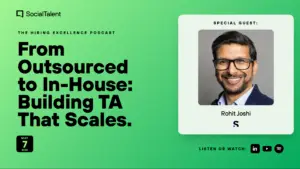
The Hiring Excellence Podcast · Episode 217
Insourcing TA: From 90% Outsourced to Global Centers
Sanofi's head of talent acquisition shares how moving from 14 RPOs to in-house global capability centers improved speed, cost, and quality of hire. Learn the process-first framework that enabled transformation at scale.
 Johnny CampbellHost · Co-founder & CEO, SocialTalent
What you'll learn
Sequence process, technology, then data before chasing predictive analytics
Build regional capability centers to flex resources across global markets
Shift stakeholder mindset from protecting local turf to strengthening the whole organization
Track how many recent hires enter the leadership succession pipeline
00:00
--:--
Episode notes
Episode key takeaways
Global capability centers (GCCs) in Hyderabad, Chengdu, Budapest, and Bogota became the engine of the transformation, allowing Sanofi to flex resources across regions while keeping account managers embedded with senior business stakeholders. This hybrid model—local relationship owners plus distributed delivery teams—solved both the control problem and the scale problem simultaneously.
Process must precede technology. Before automating or deploying AI, define the objective of each process, map all stakeholder journeys (candidate, recruiter, hiring manager), and ensure seamless execution. Only then does tech become an enabler—freeing recruiters from 60–70% admin work to focus on deep hiring strategy and market intelligence.
Succession pipeline strength emerged as a more meaningful quality metric than traditional hiring speed alone. When 50% of a business unit's leadership successors came from hires made in the prior 18 months, it signaled that TA was genuinely de-risking the organization's future talent health, not just filling open roles.
Data-driven predictive hiring requires three foundational layers: process standardization, technology infrastructure, and clean data. Without all three in place, predictive models fail to scale across 75,000 employees and 70 countries. The journey starts with the unglamorous work of process definition and global configuration.
Good to know
Frequently asked questions
The quick answers behind this episode.
How do you manage change when centralizing a decentralized TA function? +
Co-create the model with regional leaders so they have skin in the game before execution begins. Spend time with individual leaders across geographies, test ideas with business partners, and invite feedback to amend the approach. When people contribute to ideation, they become advocates during rollout, not resistors.
What's the right balance between global centers and local delivery teams? +
Retain account managers in-country closest to senior business stakeholders and hiring managers. Back them with distributed global capability centers that handle volume work and flex capacity across regions. This hybrid model preserves relationship continuity while enabling resource optimization and cost efficiency.
What metrics matter beyond speed, cost, and quality of hire? +
Track succession pipeline strength: what percentage of your leadership successors (n-1, n-2) were hired in the last 18 months? Also measure cost avoidance from strong executive hiring. These metrics reveal whether TA is genuinely de-risking the organization’s future talent health, not just filling vacancies.
Should we automate before or after standardizing processes? +
Standardize first. Automating a poor process scales the problem. Define why each process exists, map all stakeholder journeys, ensure seamless execution, then identify where technology removes friction. Tech should free recruiters to spend 70% of time on strategic work, not admin.
How do you build internal capability after years of outsourcing? +
Hire leaders with best-practice experience from other industries (e.g., employer branding from Rolls Royce, executive search from ExxonMobil). Combine their external knowledge with your organization’s culture and context. New teams can be built from scratch without legacy constraints; existing functions evolve gradually toward the new model.