Start with what you already have. Rather than hunting for new vendors, Chris Tennant's team built three custom agents directly in Microsoft Teams using Copilot Enterprise: one to capture and summarize intake briefs with hiring managers, another to standardize candidate screening notes, and a third to synthesize debrief conversations. This approach eliminated the compliance friction of introducing unfamiliar tools and accelerated adoption because recruiters were already living in Teams.
The Hiring Excellence Podcast · Episode 218
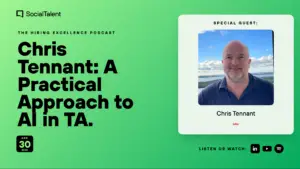
Building AI Agents for TA: A Practical 3-Step Approach
VP of Global TA at Infor shares how his team built in-house AI agents using Microsoft Copilot to streamline intake calls, candidate screening, and hiring manager debriefs—without chasing every shiny vendor.
 Johnny CampbellHost · Co-founder & CEO, SocialTalent
What you'll learn
Turn recorded intake call summaries into ready-to-use Boolean search strings
Secure explicit candidate permission before recording or screening calls
Build adoption by bringing people along instead of dictating tools
Avoid new AI vendors when existing tools already solve the problem
00:00
--:--
Episode notes
Episode key takeaways
The real ROI isn't speed—it's giving time back to recruiters so they focus on relationship-building and judgment calls. Measuring time-to-hire proved tricky due to hiring cycles, but the team found that standardized prompts forced deeper questioning during screening, surfaced core competencies faster, and reduced the waste of pursuing candidates who didn't fit the brief. Quality and consistency rose alongside recruiter satisfaction.
Adoption is the hardest part, not the technology. Rolling out new processes in November during a hiring surge taught the team to let changes bed in, then review and tweak based on user feedback rather than forcing compliance. Bringing people on the journey—using working groups that represent all regions, posing challenges instead of dictating solutions—proved far more effective than top-down mandates.
Compliance and permission must be baked in from day one. Recording calls in Teams, asking explicit candidate permission on every screening call, storing recordings for only one to two months, and moving summaries into a GDPR-compliant ATS removed legal friction and actually raised the bar for hiring manager precision during intake.
Don't chase every AI feature your ATS vendor promises. When evaluating new platforms, Tennant's team realized they didn't need deep AI integration—just the ability to copy-paste summaries into a structured field. This kept the focus on what actually saves time rather than accumulating redundant AI layers.
Good to know
Frequently asked questions
The quick answers behind this episode.
How do you get legal and compliance approval to record candidate screening calls? +
Permission is the foundation. Ask candidates explicitly on every call: ‘Can I record this?’ If they decline, don’t record. Store recordings in Teams for one to two months only. Move summaries into a GDPR-compliant ATS. Work closely with legal and compliance teams upfront to define data retention and access rules. Transparency removes friction.
What's the best way to get hiring managers to adopt AI-assisted intake calls? +
Frame it as a bar-raiser, not surveillance. When hiring managers know the call will be summarized, they tend to be more precise and thoughtful about what they communicate. Use a trusted platform they already use daily (Teams). Start with a small, representative working group across regions. Let changes bed in for a few weeks before reviewing feedback and tweaking.
Should we build AI agents in-house or buy them from an ATS vendor? +
Start with what you have. Building custom prompts in Copilot or a tool your team already uses removes vendor lock-in and compliance complexity. Most ATS vendors oversell AI capabilities; you likely don’t need them all. Simple copy-paste of summaries into structured fields often delivers the same time savings without integration headaches.
What are the biggest time-savers in AI-assisted recruiting? +
Standardized intake briefs that feed directly into Boolean search strings, reducing wasted outreach to wrong-fit candidates. Structured candidate screening that surfaces core competencies faster. Automated summaries of hiring manager debriefs that capture decision rationale. The real win is freeing recruiters from note-taking so they can ask better questions and build relationships.
How do you measure ROI on recruiting AI investments? +
Time-to-hire is tricky because hiring cycles fluctuate. Instead, track recruiter time freed per role, quality of briefs (fewer false starts), and consistency of screening depth across regions. Survey user experience: did this actually save you time? Use feedback to iterate. ROI compounds as adoption spreads and processes stabilize over months, not weeks.