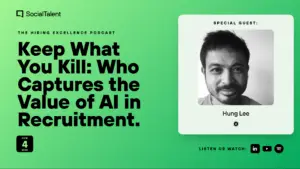
The efficiency gains from AI don't automatically flow back to employees or hiring teams. Hung Li argues that adoption success depends on a 'keep what you kill' policy: if you save time through AI, you negotiate to reinvest that time in process improvement, quality, or rest—not just hand it back to the business. Without this explicit agreement, AI becomes a negative motivation (fear of being fired) rather than a genuine productivity win.
The Hiring Excellence Podcast · Episode 227
AI Adoption in TA: Who Captures the Value?
As AI reshapes recruitment, the real question isn't whether to adopt it—it's who keeps the efficiency gains. Hung Li explores the 'keep what you kill' framework and the geopolitical risks of token-cost lock-in.
 Johnny CampbellHost · Co-founder & CEO, SocialTalent
What you'll learn
Negotiate to keep the time AI efficiency gains actually free up
Recognize that subsidized token costs can spike and lock you in
Weigh AI optimist, pessimist, and skeptic views before taking a stance
Avoid feeding company data into personal vibe-coded tools at work
00:00
--:--
Episode notes
Episode key takeaways
Twenty twenty-two marked the end of a fifteen-year hiring boom driven by zero interest rates and tech unicorn scaling. The convergence of rising rates, geopolitical tension (Russia-Ukraine), and AI arrival fundamentally reset how organizations think about recruitment. Peak recruiter—when job postings for recruiters exceeded software engineer roles in May 2021—lasted only six months before collapsing.
Token-cost subsidies create a razor-blade lock-in risk. Most large language model providers operate at a loss, burning venture capital to meter access to intelligence. If costs rise or subsidies end, organizations that replaced payroll with AI SaaS may discover they've surrendered control of their business to a third party, much like early Internet users locked into AOL. Open-source models from China could disrupt this dynamic, but introduce geopolitical complexity.
Offshoring white-collar work will accelerate if AI proves more expensive than human labor. When organizations realize AI costs exceed the salary of a skilled recruiter or auditor, they'll rehire—but not in London or New York. They'll hire in Cape Town or Budapest at lower rates. This mirrors the post-pandemic shift where roles thought to require on-site presence moved offshore permanently.
Citizen coding in corporate settings faces compliance and liability barriers. While low-code tools democratize AI capability, using them on company data without explicit approval creates data leakage, IP, and cyber-security risks. Expect employment contracts to shift liability to employees who use unauthorized AI tools, effectively killing grassroots adoption inside large organizations.
Good to know
Frequently asked questions
The quick answers behind this episode.
What is the 'keep what you kill' policy in AI adoption? +
It’s a framework where employees who achieve efficiency gains through AI get to reinvest that time as they see fit—whether in process improvement, additional automation, quality work, or personal time off. The principle recognizes that time saved doesn’t automatically revert to the employer; it must be negotiated. This flips AI adoption from a fear-driven (I’ll be fired if I don’t use it) to a value-driven motivation.
Why did the recruiter hiring boom collapse so quickly? +
Peak recruiter in May 2021 lasted only six months because interest rates began rising, pulling investment capital out of tech. Simultaneously, geopolitical tension (Russia-Ukraine) signaled the end of globalization, reducing economic growth and hiring. When AI arrived in 2022, CEOs questioned whether they needed to hire as many people at all, ending the decade-plus boom almost overnight.
What's the risk of AI token-cost lock-in for TA teams? +
Organizations replacing payroll with AI SaaS become dependent on third-party pricing. If token costs rise or subsidies end, they’ve lost control of their business model. Recent price increases from providers like Anthropic show this risk is real. Unlike human employees, you can’t negotiate with an AI provider; you either pay or lose capability.
Will AI replace recruiters or offshore them? +
If AI proves more expensive than human labor, organizations will rehire—but offshore. Post-pandemic, roles thought to require on-site presence moved permanently to lower-cost regions. The same will happen with AI: when costs exceed a recruiter’s salary in Southeast Asia or Eastern Europe, hiring shifts there rather than to expensive Western markets.
Can recruiters build their own AI tools safely? +
Citizen coding democratizes capability but creates compliance risks in corporate settings. Using low-code AI tools on company data without explicit approval risks data leakage, IP theft, and cyber-security breaches. Expect employment contracts to shift liability to employees, effectively banning grassroots AI adoption inside large organizations.