The mantra 'free up capacity to elevate capabilities' reframes automation as a productivity lever, not a cost-cutting exercise. Without removing transactional work from recruiters' plates, asking them to become strategic partners leads to burnout and service degradation. Automation must precede role expansion.
The Hiring Excellence Podcast · Episode 228
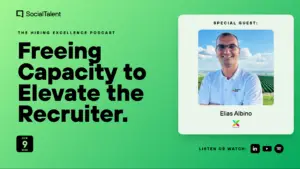
Free Up Capacity to Elevate: Automating TA for Strategic Impact
AI and automation aren't about replacing recruiters—they're about freeing them to do higher-value work. Elias Albino shares how Syngenta is redefining the talent adviser role and restructuring HR to eliminate friction between functions.
 Johnny CampbellHost · Co-founder & CEO, SocialTalent
What you'll learn
Move the strategy conversation before the requisition gets created
Take full ownership of the offer and compensation conversation
Protect junior recruiters' career path from being automated away entirely
Keep humans in the loop instead of letting AI fully decide
00:00
--:--
Episode notes
Episode key takeaways
Moving the requisition screening meeting before the job is posted—enabled by AI-powered HR agents—eliminates waste and surfaces labor arbitrage opportunities earlier. This shifts talent partners into advisory mode with hiring managers before positions are formally created, preventing costly rework and improving hiring decisions.
Elias challenges the assumption that AI should make final screening decisions. Instead, moving screening to a dedicated TA Ops function staffed by junior talent professionals creates a career pathway while preserving human judgment on nuanced, high-context roles. This balances automation gains with talent development.
HR often creates artificial barriers between functions—TA, business partnering, talent management—that fragment value delivery. Defining clear mandates through a strategic design authority and separating day-to-day HR delivery (people partnering) from strategic partnership (HRBP) reduces turf wars and clarifies who does what.
Staff augmentation and language-specific RPO partnerships can be more cost-effective than fighting for scarce bilingual recruiters internally. This hybrid model lets core TA focus on strategic placements while external partners handle high-volume, specialized recruitment needs.
Good to know
Frequently asked questions
The quick answers behind this episode.
How do you measure whether TA automation is improving hiring outcomes, not just activity? +
Track both enabling metrics (capacity freed from business partners) and qualitative outcomes: retention rates, correlation between recruitment process quality and high-potential designation, and manager perception of recruiter strategic value. Honest self-assessment—comparing how recruiters view their own strategic impact versus how hiring managers perceive it—is critical.
What transactional TA work should be automated first? +
Interview scheduling and low-hanging fruit are obvious starts, but consider moving all screening to TA Ops. This frees talent partners for manager conversations and candidate relationship-building while creating a junior talent career pathway. The goal is identifying what truly requires a talent partner versus what can be systematized.
How do you prevent AI from making unfair hiring decisions? +
Keep humans in the loop for final decisions, especially in complex, non-high-volume roles. Use AI to prioritize and simplify recruiter work, not replace judgment. European-based companies face regulatory risk if AI makes autonomous hiring decisions; the legal and ethical implications aren’t yet fully understood.
What's the difference between proper RPO and staff augmentation? +
Proper RPO means outsourcing your entire recruitment function to an external provider—viable for high-volume hiring. Staff augmentation targets specific gaps: language-specific recruitment, high-volume roles, or specialized functions where external partners complement your core team more cost-effectively than hiring internally.
How do you clarify boundaries between TA, HR business partners, and people operations? +
Define clear mandates at group level through a strategic design authority and document decisions. Separate strategic partnership (HRBP) from day-to-day HR delivery (people partnering). Assign specific responsibilities—like offer management and compensation conversations—to TA rather than leaving them ambiguous across functions.