AI embeds itself into everything, but using it to make decisions for you creates risk. The distinction between automation (speed) and elevation (insight) separates leaders who gain competitive advantage from those who waste tokens. Hallucination and poor prompting can derail analysis, so inspection of inputs and outputs is non-negotiable.
The Hiring Excellence Podcast · Episode 230
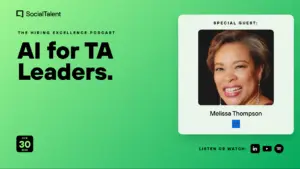
AI for TA Leaders: From Automation to Strategic Elevation
TA leaders who use AI strategically—not just tactically—unlock competitive advantage. Melissa Thompson shares how Ford's Project Bengal transformed recruiter productivity and why leaders must model AI adoption to drive organizational change.
 Johnny CampbellHost · Co-founder & CEO, SocialTalent
What you'll learn
Model AI use openly so your team follows your lead
Build a shared prompt library your whole team can reuse
Feed AI the whole metric, not isolated data points, for insight
Treat AI as a challenging thought partner, not a flatterer
00:00
--:--
Episode notes
Episode key takeaways
Melissa Thompson built Project Bengal—a rotating tiger team of three recruiters and a project manager—to handle Ford's volume challenge without adding headcount. The model evolved from resume screening to phone screening to peer-driven adoption, proving that structured, visible intervention beats top-down mandates.
Leading by example works. When a TA leader visibly uses AI to solve real problems—uncovering interview stalls, analyzing quality-of-slate metrics, building playbooks—the team follows. Competitive dynamics and peer observation drive adoption faster than training alone.
Prompt libraries and iterative refinement compound value. Storing prompts in OneNote, asking the LLM to rewrite prompts once you've achieved the desired output, and sharing monthly prompt-repair challenges create a culture of continuous improvement and token efficiency.
Managerial skills and prompting skills are nearly identical: decompose work, provide context, specify output format, ask clarifying questions before execution. Leaders already trained to manage teams are naturally equipped to extract maximum value from LLMs.
Good to know
Frequently asked questions
The quick answers behind this episode.
How do you prevent AI from wasting tokens and hitting enterprise limits? +
Maintain a prompt library so teams reuse tested prompts rather than starting from scratch. Update prompts in OneNote as you refine them. Ask the LLM to rewrite your prompt once you’ve achieved the desired output, so the next run is more efficient. Run monthly prompt-repair competitions to teach the team better prompting practices.
What is Project Bengal and how does it work? +
Project Bengal is a rotating support model where three recruiters and a project manager analyze weekly recruitment challenges and intervene on specific recs. They help with resume screening, phone screening, and unsticking positions open 60+ days. The model runs Monday (assignment), Wednesday (check-in), Friday (close-out), then repeats. Peer observation drives adoption.
How do you get your team to adopt AI if they're hesitant? +
Model usage visibly and share specific results in team meetings. Run an ‘AI corner’ where someone presents a prompt and its outcome. Conduct group prompt-repair exercises framed as competitions. Ask team members in meetings if they’ve used AI to solve problems they’re raising. Inspect what you expect by asking how they’re using AI and what value they’re seeing.
What's the difference between automating work and elevating work with AI? +
Automation speeds up existing tasks (e.g., Excel lookups, email summaries). Elevation uses AI as a thought partner to uncover insights you wouldn’t find alone—like discovering which recruiters send 50 resumes but only convert 8 to interviews, or identifying interview stalls in your funnel. Elevation requires curiosity and follow-up questions; automation is one-and-done.
How do you measure AI adoption beyond login metrics? +
Focus on business outcomes, not usage volume. Ask: Did this solve a real problem? What insight did it surface? Did it move a KPI? Run quarterly experiments where the team identifies three AI-centered initiatives tied to transformation goals. Track whether quality-of-slate, time-to-fill, or hiring manager satisfaction improved as a result.