
By Johnny Campbell
Measuring hiring success means moving past reactive metrics like time-to-fill and focusing on long-term business impact. As your strategy matures, you track the quality of hire and the revenue enabled by new team members. That shift turns talent acquisition into an actual growth engine.
What to know:
- Tracking your first-year turnover rate provides a much better indicator of hiring success than simply measuring speed.
- Evaluate your current strategy against all five levels of our Hiring Excellence Maturity Model to identify gaps.
- Structured hiring processes can help teams track these metrics more consistently across the business.
- Early-stage recruitment often prioritizes cost, which can lead to frequent re-hiring cycles and higher attrition.
- Advanced talent teams measure the commercial impact of open vacancies alongside performance outcomes for recent hires.
Why Recruiting KPIs Are So Hard to Benchmark
Let’s be honest – when it comes to recruiting key performance indicators, we all want to know how our numbers compare to others. It’s like when someone completes a marathon – you should be thinking, “Wow, that’s an amazing achievement,” but instead, the first question that comes to mind is, ” What was your time?“
Recruiting leaders are always curious about what other companies are measuring. Yet, when you attend a conference session on hiring metrics or listen to industry discussions, you’ll often find that many companies struggle to define and measure hiring success effectively.
Setting clear recruiting benchmarks before evaluating your own performance can help frame where you stand relative to industry averages.
The Problem with Traditional Hiring Metrics
Most organizations begin with a narrow focus on two key metrics:
- Time-to-hire: How quickly can we fill a position?
- Cost-per-hire: How much does it cost to recruit a new employee?
These recruiting KPIs dominate because many companies take a reactive approach to hiring. When a position opens, the immediate priority is to fill it as quickly as possible. However, as businesses mature, their hiring strategies – and the metrics they track – must evolve to focus on quality, efficiency, and long-term impact.
So, how do hiring metrics change as companies progress along the Hiring Excellence Maturity Model? And how can you avoid chasing vanity metrics that don’t align with business success?
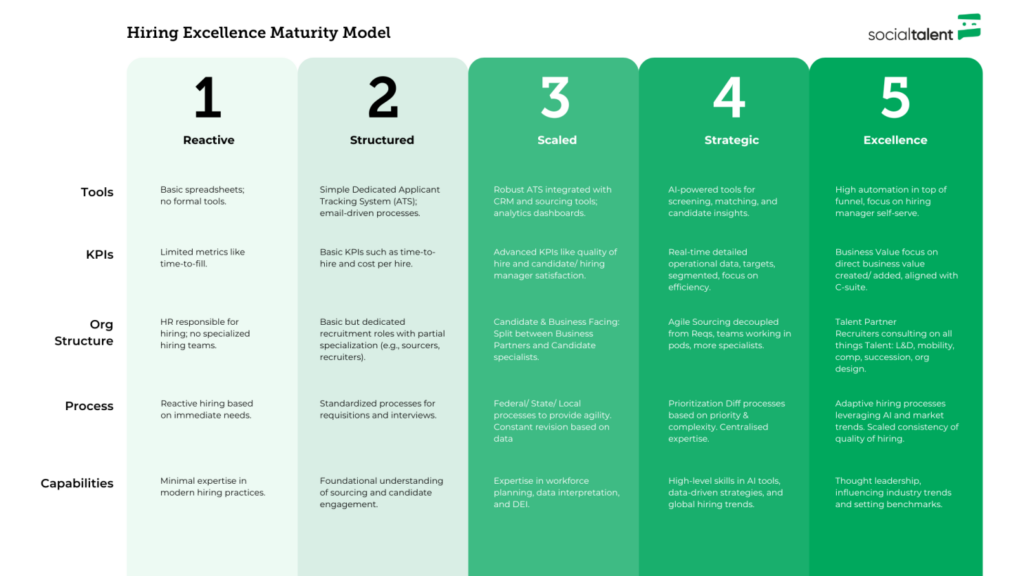
Level 1: Reactive Hiring (Speed Above All Else)
At Level 1, recruiting is entirely reactive. Hiring managers just want an open role filled ASAP. The primary KPIs at this stage include:
- Time-to-hire
- Time-to-fill
- Time-to-interview (maybe)
Here, speed is the only indicator of hiring success. However, fast hiring doesn’t necessarily mean effective hiring. If speed is the only goal, companies may experience higher attrition rates and frequent re-hiring cycles, leading to long-term inefficiencies.
Level 2: Cost Optimization (Beyond Just Speed)
As companies grow and start hiring at scale, cost-per-hire becomes a significant KPI. At this stage, leadership begins asking:
- How much are we spending on recruitment?
- Can we reduce our dependency on agencies?
- Where can we cut costs in the hiring process?
Forecasting hiring needs and optimizing for cost-effectiveness become priorities. However, unplanned hiring – due to attrition or sudden business changes – can disrupt even the best-laid plans. At this stage, hiring is still operational rather than strategic.
For a broader market view, the 2025 Hiring Reality Check is a useful companion piece.
Level 3: Quality of Hiring Takes Center Stage
At Level 3, companies shift from reactive hiring to proactive talent acquisition. They implement structured hiring processes, proactive sourcing, and align recruiting with business strategy. New KPIs include:
- Candidate experience (NPS surveys)
- Hiring manager satisfaction
- Interview effectiveness (Are we making strong hiring decisions?)
- Conversion rates (How many candidates advance through each stage?)
When candidates are dropping out, candidate experience metrics can show exactly where the process is breaking down.
Tracking the qualified candidates at each stage also helps reveal where the recruitment funnel is losing strong applicants before they reach the interview.
Quality of Hiring vs. Quality of Hire
This stage is where companies begin tracking hiring effectiveness rather than just speed and cost. However, many mistakenly believe they are measuring “quality of hire” when they are actually measuring quality of hiring – the efficiency of the process rather than the long-term success of new hires.
Level 4: Data-Driven Hiring Optimization
At Level 4, companies take a data-driven approach to hiring, breaking down recruitment metrics into deeper layers. New KPIs include:
- Time-to-source: How long does it take to find qualified candidates?
- Time-to-first-interview: Are we moving fast enough early in the process?
- Offer acceptance rates: Are we losing candidates at the final stage?
- Outbound response rates: How effective are our outreach efforts?
- Source of hire: Which sourcing channels are delivering the strongest talent pipeline?
Hiring becomes more predictable, and companies optimize for efficiency. However, many organizations get stuck here – over-focusing on process optimization without truly measuring the impact of hiring decisions.
Level 5: Measuring What Really Matters (Quality of Hire & Business Impact)
At Level 5, companies recognize that a faster, cheaper hiring process does not necessarily lead to better hires. The ultimate KPI at this stage is quality of hire, measured by:
- Performance outcomes of new hires: Are they excelling in their roles?
- Retention & promotion rates: Are we keeping and developing top talent?
- First-year turnover rate: Are new hires staying long enough to reach full productivity?
- Impact on business objectives: Is our hiring strategy driving business growth?
Here, hiring stops being a cost center and becomes a value driver. Instead of just tracking recruitment efficiency, organizations measure how hiring decisions contribute to long-term business success.
Where Does Your Hiring Strategy Stand?
Look at your recruiting KPIs. Are you still primarily measuring time-to-fill? Are you tracking quality, but only within the hiring process? Or are you actually measuring the long-term success of your hires?
From Cost Center to Competitive Advantage
The KPIs you focus on will shape your hiring strategy. If you measure only speed, recruiters will prioritize quick hires over quality fits. If cost is the main focus, hiring will become transactional rather than strategic. But if you measure the business impact of hiring, recruiting transforms from an operational process into a competitive advantage.
Many organizations want their recruiters to act as talent advisors, but if you’re only optimizing for speed and cost, you don’t need strategic business partners – you just need transactional recruiters. If you truly believe in talent advisory, you need to shift your hiring focus toward quality and long-term value.
Make Recruiting Metrics Work Harder
The best recruiting KPIs do more than report on activity. They help you build a hiring process that is more consistent, more structured, and more closely tied to business outcomes.
SocialTalent brings learning, application, and interview intelligence together in one system. If you’re ready to talk through your hiring goals, book an intro with our team.
A version of this article originally appeared in Johnny Campbell’s Talent Leadership Insights LinkedIn newsletter. Click here to subscribe!

Frequently Asked Questions
What is the difference between quality of hiring and quality of hire?
Quality of hiring measures how efficient the recruiting process is, using metrics like candidate experience, hiring manager satisfaction, and interview conversion rates. Quality of hire measures the long-term success of the people you actually bring on, such as performance and retention. Many organizations track the former while believing they’re measuring the latter.
Why do most companies start out measuring only time-to-hire and cost-per-hire?
Most organizations begin with a reactive approach to hiring, so the moment a role opens the priority is filling it fast and affordably, which is why time-to-hire and cost-per-hire dominate early-stage recruiting metrics. As hiring strategies mature, companies shift toward metrics that capture quality, efficiency, and long-term business impact instead of just speed and spend.
What KPIs indicate a mature, data-driven talent acquisition function?
A mature TA function tracks quality of hire through performance outcomes, retention and promotion rates, and first-year turnover, alongside the business impact of hiring decisions. This goes a step beyond process metrics like time-to-source or offer acceptance rate, which show efficiency but not whether new hires actually succeed and stay.
Why isn’t time-to-fill a reliable measure of hiring success?
Time-to-fill only measures how quickly a role gets filled, not whether the hire turns out to be effective. Prioritizing speed above all else can lead to higher attrition and frequent re-hiring cycles. A better indicator of success is tracking first-year turnover and performance outcomes after the hire is actually made.
What is the Hiring Excellence Maturity Model?
It’s a five-level framework describing how recruiting KPIs evolve as a talent function matures, moving from reactive speed metrics like time-to-hire through cost, process quality, and data-driven optimization, up to quality of hire and business impact at the top level. It’s used to identify where a hiring strategy sits and what to track next.