CHROs who anticipate risk and activate early—not those who wait for direction—navigate crises effectively. Jill moved to disaster recovery planning in January when China's outbreak emerged, activating IT, facilities, and board-level governance before lockdown hit. Reactive CHROs end up managing crisis; proactive ones shape it.
The Hiring Excellence Podcast · Episode 7
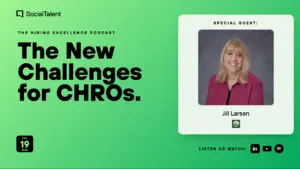
The New Challenges for CHROs with Jill Larsen
Jill Larsen joined PTC as CHRO in February 2020—one month before lockdown. She shares how CHROs who act decisively on people strategy outperform those who wait to be told, and why TA leaders can transition to HR by thinking beyond the hire.
 Johnny CampbellHost · Co-founder & CEO, SocialTalent
What you'll learn
Make hard safety-first decisions without waiting for full consensus
Recognize unequal home environments before judging remote work performance
Act on early risk signals instead of waiting to be told
Treat hiring as one stage in a full employee life cycle
00:00
--:--
Episode notes
Episode key takeaways
The transition from TA to CHRO requires seeing talent as a complete employee lifecycle, not a transaction. Many career TA leaders stop thinking once 'the rear end hits the seat.' Those who expand into onboarding, development, retention, and exit strategy position themselves for generalist HR and C-suite roles.
Authenticity and directness matter more than consensus-building in crisis. She called the decision to close offices unilaterally—even while the CEO was on vacation—because employee safety overrode relationship-building optics. Companies that prioritized people-first decisions over revenue-first ones rebounded faster.
Global CHROs face a paradox: one message alienates someone. With 50% of PTC's workforce outside the US, statements on diversity or social issues risk being either too American-centric or insufficiently local. The answer is role-modeling leadership behaviors and enforcing values consistently, not crafting perfect messaging.
Treat every meeting with an individual contributor as if it matters—because it does. Leaders often forget the weight of a C-suite meeting for someone early in their career. Showing up prepared, on time, and undistracted signals that people are genuinely valued, not just a function to manage.
Good to know
Frequently asked questions
The quick answers behind this episode.
How do TA leaders transition to CHRO roles? +
Build relationships across HR functions early, think beyond hiring into the full employee lifecycle, work in startups to gain generalist exposure, and network actively—speak at conferences, join boards, mentor others. TA leaders with strong hiring-manager relationships and business acumen are attractive to growth-stage companies seeking a people-first CHRO profile.
What should a new CHRO do in the first month? +
Understand your audience and stakeholders deeply. Assess risk and governance—especially in global organizations. Activate disaster recovery and contingency planning. Build trust with the CEO by being data-centric, business-centric, and people-centric simultaneously. Engage your board and peer CHROs to share best practices and learn from others’ missteps.
How do CHROs balance employee experience with legal and privacy risks? +
Navigate the gray zone with transparency and the golden rule: treat employees as you’d want to be treated. Contact tracing, health disclosures, and diversity statements create legal and ethical tensions (HIPAA, GDPR, political divides). Communicate honestly about what you don’t know, set clear safety-first policies, and avoid retribution to reduce anxiety and enable constructive dialogue.
What's the difference between a reactive and proactive CHRO? +
Reactive CHROs wait to be told by senior leadership; proactive ones anticipate, plan, and activate early. Proactive CHROs engage boards, collaborate across functions, share intelligence from peer networks, and test company values in real time. They help the CEO navigate crisis, not just respond to it after the fact.
How do you role-model people-first leadership as a CHRO? +
Be authentic and direct. Show up prepared and on time for every meeting, even with individual contributors. Admit when you don’t have answers. Treat emotional situations with empathy and diffuse charge before diving into solutions. Celebrate the right leadership behaviors across the organization and intervene quickly when leaders violate stated values.