Employee surveys consistently rank internal career mobility in the top two HR priorities, yet most TA organizations treat it as secondary to external hiring. Jan Ackerman's team at Oracle discovered this gap and restructured their entire talent advisory function to treat internal and external candidates identically in the hiring process—putting them in the same shortlist rather than leaving internal applicants to hiring managers' discretion.
The Hiring Excellence Podcast · Episode 11
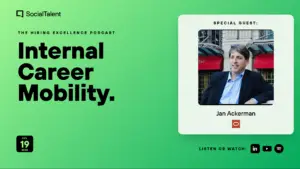
Internal Career Mobility with Jan Ackerman
Oracle's VP of Global Talent Acquisition shares how enterprise organizations are shifting from external hiring focus to internal career mobility—and why employee surveys now rank it as a top-two HR priority. Jan Ackerman reveals the process changes, leadership alignment, and communication tactics that actually work.
 Johnny CampbellHost · Co-founder & CEO, SocialTalent
What you'll learn
Treat internal candidates the same as external candidates when hiring
Lean on HR business partners to sustain mobility program success
Win senior leadership buy-in to champion internal mobility programs
Accept that only you are responsible for your career
00:00
--:--
Episode notes
Episode key takeaways
Ghosting candidates is a recruiting failure that sets the wrong cultural tone. Leading by example—personally responding to every LinkedIn message and job application with a customized note—signals to the team that candidate experience is non-negotiable, not a nice-to-have when hiring slows.
Career fairs alone don't drive mobility; the supporting infrastructure does. Clinics for LinkedIn profile updates, resume rewrites, and visibility training—tactics borrowed from campus recruiting—remove friction and signal that the organization genuinely wants people to succeed internally before they look outside.
HR business partners are the glue holding mobility initiatives together. They sit at the coalface of employee conversations about career dissatisfaction and attrition; without them co-owning the program and briefing their leadership stakeholders, even well-designed processes fail to gain traction.
Ownership of employability is the employee's responsibility, not the organization's. Setting a five-to-ten-year vision, stepping outside your comfort zone, and continuously building skills—whether technical or otherwise—is how individuals future-proof their careers across multiple roles and organizations.
Good to know
Frequently asked questions
The quick answers behind this episode.
How do you prevent hiring managers from deprioritizing internal candidates? +
Mix internal and external candidates in a unified shortlist rather than presenting them separately. Most hiring managers default to external candidates when given the choice. Changing the presentation format—and training recruiters to advocate for qualified internal talent—removes the bias without requiring managers to override their instincts.
What's the role of HR business partners in internal mobility programs? +
HRBPs field daily employee questions about career moves and attrition. They brief leadership on mobility initiatives, invite managers to career fairs, and reinforce the ‘family first’ message. Without their buy-in and active participation, even well-resourced programs fail to reach employees or shift manager behavior.
Can internal career fairs work in a fully virtual environment? +
Yes, but the model shifts. Virtual career fairs can still feature leader presentations and introductory interviews. Supporting clinics—LinkedIn profile reviews, resume rewrites, interview prep—become even more critical in a virtual setting because they remove barriers to participation and signal genuine organizational support.
How do you measure success in internal mobility initiatives? +
Track metrics beyond hiring velocity: internal fill rate, time-to-fill for internal vs. external candidates, employee engagement scores on career development, and attrition rates by tenure and role. The goal is to show that internal mobility reduces overall attrition and improves retention of high performers.
What's the first step to launching an internal mobility program? +
Survey employees on what matters to them—career development typically ranks in the top two. Form a cross-functional team including TA, HR leadership, and business partners. Secure senior leadership sponsorship and a clear ‘family first’ message. Communication and visible leadership commitment are prerequisites; process changes follow.