ASOS hiring an employer branding advisor after public layoff missteps illustrates a critical misunderstanding: employer brand recovery requires structural change, not just better storytelling. Story doing—actual shifts in how you treat people and operate—must precede any narrative repositioning.
The Hiring Excellence Podcast · Episode 14
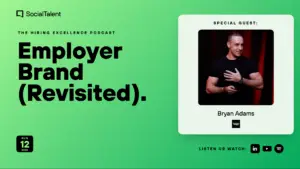
Employer Brand (Revisited) with Bryan Adams
Three months after the pandemic reshaped workplace expectations, employer brand has evolved from marketing optics to organizational transformation. Bryan Adams returns to explore how companies recover from reputation damage and why authenticity now trumps polish.
 Johnny CampbellHost · Co-founder & CEO, SocialTalent
What you'll learn
Fix employer brand through genuine action rather than better storytelling
Avoid outsourcing employer brand to marketing without HR partnership
Center employer brand strategy on how current employees genuinely feel
Measure applicant quality against talent competitors, not just application volume
00:00
--:--
Episode notes
Episode key takeaways
Marketing professionals often fail at employer brand work because they apply consumer marketing principles to an entirely different challenge. The discipline requires deep understanding of employee experience, culture fit, and organizational strategy—not just audience attraction and messaging polish.
Bryan emphasizes that current employees are the foundation of employer brand, not an afterthought. How your people feel about working for you directly shapes external perception and candidate quality, making internal authenticity the prerequisite for external credibility.
Organizations navigating social justice conversations have an unprecedented opportunity to lead with vulnerability. Admitting gaps and committing publicly to measurable change—especially when a CEO stakes their reputation on it—creates accountability that actually drives transformation rather than performative gestures.
Employer brand sits at the intersection of business strategy, culture, and people operations. Treating it as a standalone marketing or recruiting function guarantees failure; it must permeate hiring, retention, leadership behavior, and organizational decision-making at every level.
Good to know
Frequently asked questions
The quick answers behind this episode.
Can a company recover from employer brand damage like ASOS experienced? +
Yes, but only through genuine organizational change. Recovery requires doing the right things—treating supply chains with dignity, following employment law, treating employees equitably—then telling that story authentically. Hiring an employer brand specialist to communicate better without fixing underlying practices will fail. The CEO and leadership must visibly commit to transformation.
Should we hire a marketer or HR person to lead employer branding? +
Neither works in isolation. Marketing professionals bring budget and audience expertise but often misapply consumer principles to employee experience. HR recruiters understand culture but lack brand storytelling rigor. The best approach: partner marketing and HR leadership, with the CHRO as essential stakeholder. Employer brand requires both disciplines working together, not one replacing the other.
How do we measure employer brand success? +
Move beyond vanity metrics like Glassdoor ratings. Track talent flow sources, measure the percentage of qualified applicants (not just volume), and benchmark against direct talent competitors. Monitor whether your external candidate pool reflects your culture add criteria. These indicators reveal whether you’re attracting the right people, not just more people.
What should employer brand specialists prioritize right now? +
First, research the current reality from employee perspective and leadership’s aspirational view. Understand where the organization must change to stay relevant. Document that transformation story authentically. Demand conviction from leadership about change commitment. Then use that narrative internally to galvanize employees and externally to attract culture-matched candidates who want to join the journey.
Why is employer brand similar to diversity, equity, and inclusion work? +
Both are organizational layers that permeate everything, not one-time initiatives. You can’t isolate them as standalone programs. Employer brand touches hiring, retention, leadership behavior, and culture. Like DEI, it requires sustained commitment, measurement, and integration into how the business operates—not a project you complete and move on from.