Recruiters don't hire; leaders do. The insight flips the accountability model: if hiring quality lives with leaders, then measurement and ownership must too. This reframe moves TA from a support function into a strategic partnership where both parties own the outcome.
The Hiring Excellence Podcast · Episode 45
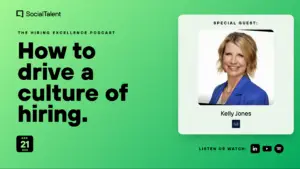
How to drive a culture of hiring | with Kelly Jones
Hiring isn't a recruiter's job—it's everyone's. Kelly Jones, VP of Global Talent Acquisition at Cisco, explains how to shift from siloed hiring to a culture where leaders become talent magnets and every employee feels responsible for sourcing.
 Johnny CampbellHost · Co-founder & CEO, SocialTalent
What you'll learn
Recognize hiring decisions belong to leaders, not recruiters, to build accountability
Coach hiring managers into becoming talent magnets who attract passive candidates
Assess candidates for learning agility instead of a rigid skills checklist
Embed fairness into every recruiting step instead of isolating it in one team
00:00
--:--
Episode notes
Episode key takeaways
Time is the scarcest resource. Hiring managers deprioritize recruiting not from malice but from bandwidth constraints. The solution isn't exhortation—it's removing friction, coaching on storytelling and LinkedIn presence, and embedding hiring into performance metrics so it competes for attention alongside revenue targets.
Skills-based hiring unlocks both diversity and retention. Moving away from twenty-point checklists toward learning agility and capability-based assessment opens doors to non-traditional candidates and drives higher engagement and retention. The data shows reskilled hires outperform traditional fits.
Onboarding belongs in TA because recruiters know candidate strengths and gaps. By connecting interview insights to personalized onboarding plans, TA bridges the handoff and ensures new hires are ramped to full productivity faster—turning hiring into a continuous experience, not a transaction.
Diversity and inclusion must be embedded in every step, not siloed. When D&I lives in a separate team, it stalls. Fairness metrics, transparent leadership conversations, and system-level accountability ensure inclusive hiring survives leadership changes and becomes how the organization operates.
Good to know
Frequently asked questions
The quick answers behind this episode.
How do you measure a hiring culture? +
Start with tactical metrics: referral volume and quality from leaders, percentage of staff badged in talent magnet training, and candidate experience scores for both hired and rejected candidates. Sentiment—everyone feeling responsible for hiring—is harder to measure but can be tracked through engagement surveys and referral behavior over time.
What's the best way to get hiring managers to prioritize recruiting? +
Make it a KPI. People do what they’re measured and paid to do. Without measurement, recruiting stays noise on top of fifty other priorities. Pair metrics with executive modeling from the top—if senior leaders don’t visibly own hiring, middle managers won’t either.
How do you build a talent magnet culture at scale? +
Train leaders one-to-one on storytelling, LinkedIn presence, and passive candidate engagement. Use a badging system to track progress. Showcase success stories of non-traditional hires who flourished. Make it self-reinforcing: as leaders see results, they keep going. External hires with strong TA expectations also create healthy pressure.
Why should onboarding sit with talent acquisition? +
Recruiters have deep insight into each candidate’s strengths and development gaps from the interview process. That knowledge can be translated into personalized onboarding plans and learning paths. It also ensures the candidate experience during hiring connects seamlessly to day-one experience, reducing cultural immersion gaps.
How do you embed diversity into hiring without a separate D&I team? +
Fairness metrics and transparency must be woven into every recruiting step—sourcing, screening, interviewing, offer. Measure who’s coming in, how they advance, and outcomes. Make it a system, not a person, so it survives leadership changes. Model brave, uncomfortable conversations from the top down.