Event-based recruiting doesn't scale in volatile markets. Candidates won't wait two or three years for an opportunity, no matter how noble the mission. The shift from passive, relationship-building events to proactive sourcing, talent pools, and market intelligence became non-negotiable—especially when competing for specialized roles like forensic specialists, surgeons, and security analysts across multiple continents.
The Hiring Excellence Podcast · Episode 49
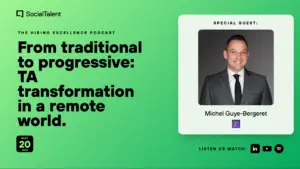
From traditional to progressive: TA transformation in a remote world | with Michel Guye-Bergeret
The ICRC's global TA leader shares how a distributed team pivoted from event-based recruiting to proactive, data-driven talent strategy—without massive budgets. Learn what actually builds trust in remote teams and why attitude matters more than tools.
 Johnny CampbellHost · Co-founder & CEO, SocialTalent
What you'll learn
Build trust deliberately through attitude and intention, not chitchat
Give team members space to act and fail
Deliver market insights and advisory instead of just filling roles
Blend multiple disciplines into a single talent function
00:00
--:--
Episode notes
Episode key takeaways
Team engagement is the prerequisite for transformation, not the outcome. Starting with a 59% satisfaction rate, the move to 82–89% came from radical transparency about strategy, explicit permission to disagree, and genuine support for people choosing different paths. Losing 30–40% of the team who didn't align with the new direction was acceptable; forcing consensus would have failed.
AI in recruitment has a dream and a reality. Michel uses two concrete tools: one for writing inclusive job descriptions and employer branding copy, another for hyper-targeted campaign reach. The promise is loud, but real value emerges only when expectations are grounded and implementation is deliberate—not when chasing hype.
Three-sixty recruiting roles attract senior talent and deliver disproportionate value. By combining sourcing, market analysis, employer branding, event management, and strategic advisory into one role, the team delivers data context alongside placements. Internal clients see not just a job posting but market insights, retention forecasts, and strategic recommendations.
Building trust remotely requires daily intention and attitude, not virtual coffee breaks. Across seven time zones, the manager's job shifted from chitchat to creating fertile ground for growth: removing obstacles, offering space to fail, asking how to support, and asking at the end of every conversation: did I build trust today?
Good to know
Frequently asked questions
The quick answers behind this episode.
How do you transition a TA team from event-based to proactive recruiting? +
Start with transparency about why change is necessary—candidates won’t wait, competition moves fast. Introduce sourcing fundamentals and Boolean search, then layer in proactive talent pools and market intelligence. Accept that 30–40% of the team may not follow; support them in finding their next role. The shift takes time but builds credibility when people see the data and advisory value.
What tools do you need for modern TA without a big budget? +
Sourcing tools, a strong ATS for pipelining, and market intelligence data are non-negotiable. For reporting and dashboards, creativity with Excel and PowerPoint can replace expensive platforms like Tableau. Prioritize where you add value first, then invest incrementally. The ICRC built a hyperlinked reporting system that became a benchmark—at zero cost.
How do you build trust in a fully remote, distributed TA team? +
Forget virtual escape games and coffee breaks. Focus on attitude and intention: be transparent about strategy, give people space to fail and act, ask what support they need, and remove obstacles daily. At the end of every conversation, ask yourself: did I build trust? This daily practice moved team satisfaction from 59% to 82–89%.
What character traits make a successful recruiter in humanitarian aid? +
Beyond technical skills, recruiters must understand they’re changing someone’s life, not just moving them to a new job. Resilience, self-awareness, and ability to cope with stress and volatility matter more than domain expertise. They must also recognize a spectrum of motivation—some join for life, others for two years—and sell accordingly without compromising the mission.
What's the next evolution after proactive recruiting? +
Predictive recruiting. The goal is to call a meeting with a leader before they know they need to hire, armed with data showing likely departures in 6–12 months, a shortlist, and a proposal. This requires mastering market data and people analytics at scale. The ICRC aims to reach this stage in two to three years.