Neurodiversity extends far beyond autism. ADHD, dyslexia, dyspraxia, and other neurological differences are systematically excluded from workplace conversations—and the consequences are severe: disproportionate prison populations, unemployment rates, and untapped talent pools that organisations ignore because they're invisible on a résumé.
The Hiring Excellence Podcast · Episode 55
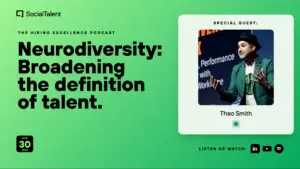
Neurodiversity: Broadening the definition of talent | with Theo Smith
One in five workers is neurodiverse, yet only 4% of companies mention disability in DEI efforts. Theo Smith reveals how standard recruiting processes exclude hidden talent and what hiring teams can do immediately to broaden their definition of fit.
 Johnny CampbellHost · Co-founder & CEO, SocialTalent
What you'll learn
Ask candidates directly what support they need at each interview stage
Share interview questions in advance instead of assuming candidates can prepare instantly
Avoid judging candidates on gut instinct, eye contact, or culture fit
Redesign interview environments to remove sensory and access barriers for candidates
00:00
--:--
Episode notes
Episode key takeaways
Job descriptions, interview formats, and assessment tools are designed by and for the neurotypical majority. Company jargon, vague questions, multi-stage processes without accommodation offers, and overstimulating environments aren't intentionally hostile—they're just blind spots. Asking candidates at each stage 'How can we help you?' costs nothing and unlocks access to people who would otherwise self-select out.
Theo Smith argues that 'culture fit' is code for homogeneity. Gut instinct, beer-test hiring, and subjective panel impressions systematically favour people who think, communicate, and socialise like the interviewer. The science is clear: structured questions tied to job requirements, plus points for difference rather than conformity, yield fairer outcomes and better team performance.
Open-plan offices, constant interruptions, and always-on collaboration crush neurodivergent workers. Some need hyper-focus and quiet; others need movement and people. Neither is wrong. Respecting different working styles—async communication, flexible environments, breaks between tasks—isn't accommodation; it's recognising that productivity and wellbeing vary by individual, not by role.
The barrier isn't complexity; it's mindset. Smaller organisations can rewrite job descriptions immediately. Larger ones can start with early-stage communications and personalised outreach. The point isn't to wait for perfect systems—it's to act now on what you control, then iterate. Neurodiversity affects 20% directly and 50%+ indirectly through family and colleagues.
Good to know
Frequently asked questions
The quick answers behind this episode.
What counts as neurodiversity in the workplace? +
Neurodiversity includes ADHD, autism, dyslexia, dyspraxia, dyscalculia, and Tourette’s. Many people have multiple conditions simultaneously. It’s not a disability label—it’s a neurological difference. The key: one in five workers is neurodiverse, yet most organisations focus narrowly on autism and high-functioning STEM roles, missing the broader talent pool and the complexity of intersecting conditions.
Why do standard interviews exclude neurodiverse candidates? +
Interviews are inherently stressful and non-standard. Vague questions, lack of advance notice, multi-stage processes without accommodation offers, busy environments, and subjective panel assessments all create anxiety and barriers. Neurodiverse candidates may struggle with eye contact, processing speed, or sensory overload—none of which predict job performance. Simple fixes: provide questions in advance, ask how to help at each stage, and assess skills, not personality fit.
How do I make job descriptions more accessible? +
Remove company jargon, internal acronyms, and unnecessary length. Be specific about requirements and responsibilities. Avoid vague phrases like ‘self-starter’ or ‘team player.’ Smaller organisations can rewrite immediately; larger ones can start with early communications and personalised outreach. The goal: clarity so candidates understand what’s being asked, reducing anxiety and self-selection bias.
What's the difference between neurodiversity and disability? +
Not all neurodivergent people identify as disabled. Some see themselves as differently abled with hidden abilities, not hidden disabilities. However, barriers in recruitment, workplace design, and culture can disable anyone. The legal and HR fear around ‘disability’ often prevents organisations from asking simple questions or making reasonable adjustments that benefit everyone, not just those who tick a box.
How do I challenge 'culture fit' bias in hiring? +
Replace subjective gut instinct with structured questions tied to job requirements. Award extra points for difference and unique perspectives, not conformity. Recognise that ‘beer test’ hiring and homogeneous teams limit innovation. Culture fit is often code for ‘people like us.’ Instead, ask: Does this person have the skills and values to do the job well? What new perspective do they bring?