Onboarding starts the moment a candidate accepts an offer, not on day one. This pre-boarding window lets organizations complete administrative work, personalize communications, and establish manager connection before the hire's first day—eliminating first-day anxiety and accelerating time-to-productivity.
The Hiring Excellence Podcast · Episode 61
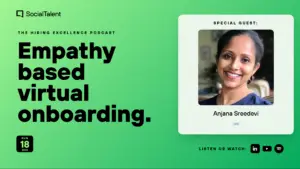
Empathy based virtual onboarding | with Johnny Campbell
Only 12% of employees think their company onboards well. Anjana shares how IBM redesigned virtual onboarding for 26,000 hires during the pandemic, prioritizing emotional experience and personalization to drive NPS 66 and 93% welcome rates.
 Johnny CampbellHost · Co-founder & CEO, SocialTalent
What you'll learn
Start onboarding the moment a candidate accepts, not on day one
Measure onboarding success by how new hires feel, not just retention
Ask new hires how they're feeling before asking about logistics
Split long orientation sessions into shorter, more interactive touchpoints
00:00
--:--
Episode notes
Episode key takeaways
Empathy-based onboarding means tracking emotional experience, not just task completion. Anjana's team shifted survey questions from 'Did you get your laptop?' to 'How are you feeling? Are you anxious? What can we help with?'—a reframe that revealed where support was actually needed.
Three critical moments define the virtual onboarding journey: moments of emotion (awkwardness or discomfort), moments of uncertainty (fear of asking questions), and moments of change (process shifts). Identifying and designing for these moments separately yields better outcomes than treating onboarding as a linear checklist.
Fail fast, iterate, and communicate across silos. Shipping laptops seemed obvious until IBM discovered missing shipping contracts in some countries and incorrect addresses for relocated hires. Success required constant partnership between TA, hiring managers, IT, legal, and logistics.
Measurement matters. IBM tracks NPS, whether new hires feel welcomed despite virtual format, reassurance about joining after 30 days, and retention—not just information retention. Fifty percent of organizations measure nothing; moving to emotion-based metrics correlates with better engagement and retention outcomes.
Good to know
Frequently asked questions
The quick answers behind this episode.
How long should virtual onboarding actually take? +
Data shows six to twelve months for full onboarding, though most leaders underestimate this. IBM’s research found 39% of organizations target 90 days, 23% six months, and only 6% claim one week. Anything less than six months typically means critical gaps remain unfilled.
What's the biggest obstacle to virtual onboarding? +
Ensuring new hires feel socially integrated and connected to the team ranks first, followed by alignment with company goals. The absence of in-person interaction makes it easy for hires to feel isolated despite digital tools. Intentional culture-based networking and regular one-on-one check-ins address this directly.
How should companies measure onboarding success? +
Move beyond retention of information to tracking how employees feel. NPS scores, whether hires feel welcomed, and reassurance about their decision to join (measured 30 days in) are stronger predictors of retention and engagement than task-completion metrics. IBM achieved NPS 66 and 93% welcome rates using this approach.
What makes virtual onboarding personal, not just digital? +
Personalization at scale requires tailoring the experience to location, role, skill level, and seniority from day one. Custom videos from employees working from home, culture-based networking groups, and empathetic messaging that acknowledges anxiety make the digital experience feel human. IBM’s welcome session satisfaction actually exceeded pre-pandemic levels using this model.
How do you handle onboarding logistics when hires can't come to an office? +
Make paperwork 100% digital to eliminate anxiety about printing, mailing, or in-person drop-offs. Ship laptops directly to hires’ addresses, but verify addresses are current—many relocated during the pandemic. Provisioning and IT setup require constant iteration and cross-team communication to solve country-specific challenges.