Strategy is only as good as the assumptions underneath it. Most organizations articulate objectives and budgets clearly, but fail to document the assumptions about hiring speed, candidate pool size, reskilling needs, and market dynamics that drive those plans. When assumptions change—and they will—the strategy must change too, not get defended.
The Hiring Excellence Podcast · Episode 64
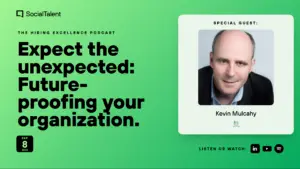
Expect the unexpected: Future-proofing your organization | with Kevin Mulcahy
Volatility is the new normal. Kevin Mulcahy explains why scenario planning fails and how assumption-based strategy—paired with a culture of experimentation—lets TA leaders adapt faster than the market shifts.
 Johnny CampbellHost · Co-founder & CEO, SocialTalent
What you'll learn
Document your planning assumptions so you know when to change course
Define culture as the worst behavior you tolerate, not wall slogans
Ask candidates about hobbies to reveal whether they're active learners
Reward employees who stop failing projects early instead of pushing through
00:00
--:--
Episode notes
Episode key takeaways
Kevin argues that bets belong in casinos, not boardrooms. Framing initiatives as 'big bets on the future' signals rigidity; reframing them as experiments—smaller commitments tested in six-month increments with permission to pivot—unlocks agility. The goal shifts from proving you were right to learning what works.
Culture is the worst behavior you're willing to tolerate, not the values on your wall. If you haven't actually fired someone for breaching stated values, you don't have a culture—you have aspirations. Hiring for culture means hiring for people who will hold each other accountable to those standards when leadership isn't in the room.
Flatten structure and turbocharge decision-making only work if trust is real. Pushing decisions down the hierarchy requires hiring learners who believe in the mission and competent people you trust to act within budget parameters. The Irish saying applies: don't get a guard dog if you're going to do all the barking yourself.
Hire for learning and teaching, not just expertise. Candidates who demonstrate how they've shared knowledge—via coaching, mentoring, or creating learning environments—scale organizational capability faster than solo experts. In a fast-moving business, dependencies kill you; distributed expertise wins.
Good to know
Frequently asked questions
The quick answers behind this episode.
How do you plan hiring strategy when the future is uncertain? +
Document your assumptions explicitly: growth rate, hiring speed, candidate availability, reskilling needs. For each assumption, define what would be ‘unexpected’—e.g., hiring 30 instead of 50 people. When reality diverges from your assumptions, that’s your signal to revisit strategy. This beats scenario planning because it forces clarity upfront and gives you permission to adapt mid-year.
What questions reveal if a candidate is a learner? +
Ask about hobbies and how they learn outside work. Woodworking, coaching, or mentoring signal active learning. Then ask: how have you taught others? The best hires are both learners and teachers—they absorb expertise and distribute it, preventing organizational bottlenecks and scaling capability.
How do you actually hire for culture, not sameness? +
Hire for values you’re willing to fire for. Ask hiring managers: ‘Tell me about someone you fired for breaching our values.’ If they can’t answer, you have no culture—just aspirations. Culture is the norms people hold each other to when leadership isn’t watching, not the phrases on your wall.
Why does scenario planning fail in volatile markets? +
Scenario planning assumes you can anticipate possible outcomes and build robust strategies to withstand them. But unknown unknowns—the pink swan, the yellow elephant—can’t be planned for. Assumption-based planning works better: state what you expect, flag what would surprise you, and commit to revisiting strategy when reality breaches those boundaries.
What's the key to staying agile when plans change? +
Treat all strategies as experiments, not big bets. Make smaller commitments, test in six-month increments, and build a culture where stopping an initiative early is rewarded as bravery, not failure. This requires permission to say ‘this isn’t working’ and reallocate budget—the opposite of pre-pandemic thinking.