Going slow to go fast isn't a cliché—it's a competitive advantage. When organizations pull the trigger on hypergrowth without a long-term strategy, they create cultural fractures, seniority imbalances, and retention problems that compound for years. The data backs it: planning for an 11-month calendar year (not 12) and adding 10–15% buffer for holidays and attrition prevents the burnout that kills scaling efforts.
The Hiring Excellence Podcast · Episode 72
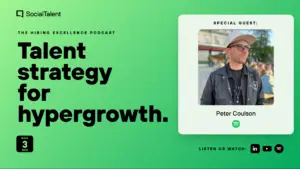
Talent strategy for hypergrowth | with Peter Coulson
Scaling a team by 250% in a year sounds ambitious—until your managers arrive with no cultural context and burnout becomes inevitable. Peter Coulson shares how to build sustainable growth strategies that actually work.
 Johnny CampbellHost · Co-founder & CEO, SocialTalent
What you'll learn
Slow initial scaling decisions to avoid long-term culture and hiring damage
Build a data-backed case to earn talent acquisition a seat at the table
Launch a simple internal job marketplace to retain employees during hypergrowth
Pad headcount forecasts by ten to fifteen percent to cover inevitable disruption
00:00
--:--
Episode notes
Episode key takeaways
New managers hired to build teams from scratch need more than a headcount target. They need cultural onboarding, mentorship, and realistic timelines. Expecting a manager to scale a team by 250% in their first six months isn't ambition—it's a setup for failure that damages both the hire and the business.
Internal talent marketplaces aren't nice-to-haves; they're retention infrastructure. When 72% of tech workers are considering leaving within a year, the opportunity isn't just external hiring—it's offering existing employees lateral moves and growth paths before they look outside. A simple weekly email with hot internal roles can be a starting point; larger orgs should invest in centralized career sites.
Smaller companies have a structural advantage over giants: impact. A developer at a 50-person startup can see their work reach customers directly; at a 50,000-person org, they're a cog. Positioning roles around ownership, technical challenge, and visible business impact differentiates startups from FAANG when competing for STEM talent.
Relationship-building is the only defensible moat in a tech-driven recruiting world. Understanding each candidate's specific wants versus needs—and matching them to roles that fulfill both—removes competition from the equation. This takes time upfront but reduces turnover and hiring cycles downstream, making it a net time gain.
Good to know
Frequently asked questions
The quick answers behind this episode.
How do I plan TA headcount for hypergrowth without burning out my team? +
Plan for an 11-month calendar year, not 12, accounting for holidays and time off. Add 10–15% buffer on top of your headcount targets to absorb attrition and unexpected shifts. Build a mix of junior, mid, and senior recruiters so workload is distributed. Overplan rather than underplan—there’s always more to do in recruitment, so extra capacity won’t go unused.
What should I do now to prepare for next year's scaling? +
Start building internal career visibility: create a weekly email or internal job board showcasing open roles to existing employees. Develop relationships with hiring managers to identify high-potential people ready for lateral moves. Upskill your team on business acumen so you can sit at the table during strategic planning. Plan for the unexpected by building variance into your headcount forecasts—assume priorities will shift mid-year.
How do I retain tech talent when 72% say they're considering leaving? +
Retention strategy can’t start when people are already leaving—it should have started years ago. But now, focus on internal mobility: showcase growth opportunities across the organization, encourage lateral moves, and help managers identify talent ready for new challenges. Invest in career development and ensure people see a path forward without leaving the company.
How can small companies compete with Google and Spotify for STEM talent? +
Lead with impact and ownership. Developers at startups see their work reach customers directly; at large orgs, they’re one of thousands. Position roles around technical challenge, visible business impact, and the chance to wear multiple hats. Build relationships with candidates to understand their specific needs—then show how your smaller org fulfills them better than a giant.
Should I worry about internal poaching if I promote internal job opportunities? +
Internal movement isn’t a problem if it’s done ethically and for the right reasons. Managers should be willing to sacrifice strong team members for their growth and development. As a TA leader, help identify gaps and match people to opportunities where they’ll flourish. The business benefits from retaining talent and keeping people engaged, even if they move teams.