The designated driver effect works in hiring too. When Hollywood normalizes diverse representation on screen, candidates arrive at interviews with higher expectations for inclusion—forcing organizations to compete on culture, not just compensation. This isn't abstract: Gen Z candidates are already walking away from employers with visible pay gaps.
The Hiring Excellence Podcast · Episode 74
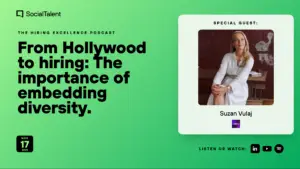
From Hollywood to hiring: The importance of embedding diversity | with Suzan Vulaj
How mainstream media normalizes inclusion—and why recruiting teams must do the same. Suzan Vulaj shares NBCUniversal's playbook for operationalizing DEI across 35,000 employees and closing the gap between stated commitments and real change.
 Johnny CampbellHost · Co-founder & CEO, SocialTalent
What you'll learn
Expand anti-bias training beyond hiring managers to every interviewer involved
Build two-way listening sessions so DEI training becomes dialogue not messaging
Create a dedicated DEI role inside talent acquisition linking ERGs and TA
Track employee sentiment surveys to benchmark ongoing DEI commitment progress
00:00
--:--
Episode notes
Episode key takeaways
Ninety-seven percent of employers claim new inclusion measures exist, yet only 24 percent of employees believe it. The disconnect isn't a messaging problem; it's an action problem. Suzan's team addressed this by embedding anti-bias training into every layer of the hiring process—not just job descriptions, but hiring managers, interviewers, and performance reviewers.
Measurement requires both hard and soft metrics. Survey data showed 90 percent agreement that NBCUniversal is committed to DEI, but the real work happens downstream: tracking representation by department, benchmarking against external labor markets, and asking why gaps exist before blaming the pipeline.
Operationalizing diversity means breaking it down by business unit, role, and skill level—not setting one company-wide target. One department may be thriving on a diversity lens while another struggles; the solution isn't 'work harder,' it's retraining and internal mobility programs like Act Two, which brought back career-returners into tech roles.
DEI cannot live in TA alone. Embedding senior diversity leads into every business unit—sports, ad sales, news, streaming—creates accountability and cross-functional dialogue. When DEI becomes normalized infrastructure rather than an initiative, it stops being a program and starts being how the organization operates.
Good to know
Frequently asked questions
The quick answers behind this episode.
How do you measure DEI progress in recruiting? +
Use pulse surveys to track employee perception (NBCUniversal found 90% agreement on commitment), analyze demographic data internally, and benchmark against external labor markets. Understand what the talent pool actually looks like before assuming a pipeline problem. Combine quantifiable metrics with qualitative feedback from listening sessions and focus groups.
What's the difference between DEI initiatives that work and those that don't? +
Initiatives that work are operationalized—broken down by department and role with clear accountability—and embedded into day-to-day processes, not treated as one-off programs. They require two-way dialogue, not one-way messaging. Meet the Moment succeeded because it engaged 35,000 employees across multiple sessions with external experts and internal resource guides, then measured impact.
How do you reduce bias in the hiring process? +
Train not just hiring managers but everyone in the interview loop—interviewers, HR partners, and people leaders. Use tools to debias job descriptions and applications. Create standardized interview questions and rubrics. Provide hiring managers with inclusive job description templates and accessibility checklists. Make these resources visible and embedded in every recruiting kickoff.
Why should TA care about what's happening in mainstream media? +
Candidates are shaped by what they see on screen. When media normalizes diverse representation, candidates expect the same from employers. This raises the bar for employer brand and culture competitiveness. TA leaders who understand this connection can better articulate why DEI investments matter to the business—it’s not just ethics, it’s talent acquisition strategy.
How do you scale DEI across a large, multi-business organization? +
Embed senior DEI leads into each business unit rather than centralizing all DEI work. Create a centralized TA function that can share best practices across silos. Establish cross-functional partnerships with L&D, organizational development, and HR. Use shared tools and resources (like hiring manager toolkits) while allowing each business to own progress in their context.