Anti-Asian sentiment didn't emerge with COVID; it resurged. A 1,662% spike in online hate speech during early 2020 masked centuries of disease-association stereotypes, xenophobic scapegoating, and deliberate erasure from British institutional life. The pandemic simply gave dormant prejudice permission to surface.
The Hiring Excellence Podcast · Episode 77
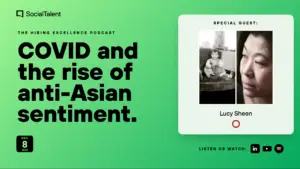
COVID and the rise of anti-Asian sentiment | with Lucy Sheen
COVID-19 triggered a 1,662% surge in anti-Asian hate speech online, with real-world violence following. Lucy Sheen explores how historical bias, media misrepresentation, and workplace exclusion persist—and what hiring leaders must do differently.
 Johnny CampbellHost · Co-founder & CEO, SocialTalent
What you'll learn
Explain how the term Asian covers different regions in UK versus US usage
Spot the danger of hiring cultural consultants and then ignoring their input
Identify the unwritten rule limiting dramas to one East Asian character
Understand the added marginalization mixed-heritage people face fitting into either culture
00:00
--:--
Episode notes
Episode key takeaways
Definitions of 'Asian' fracture hiring and representation. In the UK, 'Asian' typically means South Asian only—excluding East and Southeast Asians entirely. This linguistic gatekeeping mirrors colonial hierarchies: only former empire territories (cricket-playing nations) gain mainstream recognition, while China, Korea, and Vietnam remain perpetual outsiders.
One character per drama, always supporting a white narrative. British media consistently casts East Asians as sidekicks or stereotypes, never as protagonists of their own stories. Lucy points out that a white writer depicting Chinese characters baking dumplings in an oven faced no consequences—yet would be 'hung, drawn and quartered' for similar sloppiness about World War I uniforms.
Representation without power behind the camera changes nothing. Sesame Street's first Asian American puppet after 52 years is progress, but only if writers, producers, and commissioners reflect the communities they depict. Schemes and tokenism distract from the real ask: investment, commissions, and hiring decisions.
Streaming platforms are outpacing legacy broadcasters on diversity. Netflix's Squid Game and Bridgerton prove global audiences will pay for authentic, non-white-centered stories. Yet the BBC—publicly funded by British taxpayers—lags behind. The shift reveals that gatekeepers, not audiences, have been the bottleneck.
Good to know
Frequently asked questions
The quick answers behind this episode.
How did COVID-19 accelerate anti-Asian hate speech and violence? +
Online hate speech targeting Asians surged 1,662% in early 2020, peaking in March as the pandemic spread. Within months, anti-Asian hate crimes in London rose 80%. The virus became a pretext for scapegoating, but the underlying prejudice—disease association, xenophobia, othering—traces back centuries, not to 2020.
Why is 'Asian' defined differently in the UK versus the US? +
In the UK, ‘Asian’ predominantly refers to South Asia (India, Pakistan). East and Southeast Asians are excluded entirely. In the US, ‘Asian’ encompasses the entire continent. This reflects colonial legacies: Britain recognizes former empire territories (cricket-playing nations), while China and Korea remain perpetual foreigners.
What's the difference between representation and authentic inclusion in media? +
Authentic inclusion requires decision-makers—writers, producers, commissioners—from the community being depicted. A BBC children’s show written by an all-white team with a cultural consultant whose concerns were ignored produced stereotypes (baked dumplings, racist slurs). Representation without power behind the camera perpetuates harm.
How should hiring leaders approach casting and recruitment for diverse teams? +
Avoid schemes and tokenism. Instead, invest in hiring, commission diverse talent, and normalize mixed-heritage and East/Southeast Asian candidates in roles unrelated to their ethnicity. Stop restricting people of color to ‘authentic’ or stereotypical roles. Treat hiring like casting: judge capability, not cultural fit or perceived authenticity.
Why do streaming platforms succeed where legacy broadcasters fail on diversity? +
Netflix, Amazon, and Apple greenlight content based on audience demand and quality, not gatekeeping assumptions. Squid Game and Bridgerton proved global audiences will engage with non-white-centered stories. Legacy broadcasters like the BBC, despite public funding, remain risk-averse. The market has already answered the question: diverse content sells.