Ontological arrogance—the assumption that everyone shares your experience—blinds leaders to what's actually happening for employees different from them. Until leaders actively learn about others' lived experiences through safe, trusting relationships, they're operating on incomplete information and making decisions that miss the mark.
The Hiring Excellence Podcast · Episode 91
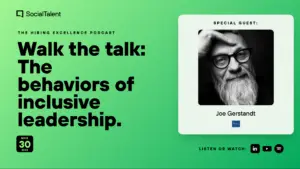
Walk the talk: The behaviors of inclusive leadership | with Joe Gerstandt
Most organizations claim to be inclusive but can't explain what it means in practice. Joe Gerstandt breaks down the specific behaviors leaders must demonstrate—and how to measure them—to build genuinely inclusive cultures.
 Johnny CampbellHost · Co-founder & CEO, SocialTalent
What you'll learn
Build inclusive leadership through deliberate action, not stated intentions
Assess psychological safety by asking if disagreement and failure are safe
Measure leaders on inclusive behaviors instead of only outcome numbers
Spot the tendency to assume everyone shares your workplace experience
00:00
--:--
Episode notes
Episode key takeaways
Intention without action is fitness advice you never follow. Agreeing that inclusion matters doesn't make you inclusive any more than believing in fitness makes you fit. Joe emphasizes that inclusive leadership requires deliberate, proactive behaviors: reducing bias in hiring and promotion, increasing psychological safety, building diverse networks, and holding yourself accountable to measurable standards.
Behavioral expectations are the missing link in most DEI programs. Organizations build ERGs, diversity councils, and awareness campaigns but skip the hard part: defining what inclusive leaders actually do, writing those behaviors into job descriptions, and measuring them in performance reviews and promotion decisions.
Psychological safety—the ability to tell the truth without fear—is the foundation. Research shows women are interrupted more, get less candid feedback, and face consequences for dissent. Leaders must prove they're safe to share bad news, disagreement, and failure by responding without dismissal, blame, or explanation.
Metrics matter, but granularity matters more. Overall diversity statistics can mask serious problems in specific departments or regions. Dig into retention, engagement, and promotion rates sorted by demographic group, then ask employees directly: Do you feel included? Safe to contribute? Seen and valued? The gaps reveal which behaviors need to change.
Good to know
Frequently asked questions
The quick answers behind this episode.
What is the difference between diversity, inclusion, and equity? +
Diversity means difference—the ways human beings vary. Inclusion is an ongoing process of change that produces two outcomes: a sense of belonging for individuals and equitable outcomes for groups. Equity acknowledges that people need different accommodations to reach fair results. For example, women need protection from interruption; people with disabilities need physical access. Equal treatment isn’t equitable treatment.
How do you measure psychological safety on a team? +
Key questions include: Is it safe to be unpopular? Safe to disagree with your boss? Safe to share bad news or admit failure? Safe to ask for help? Do we disagree enough and disagree well? These assess whether team members trust each other enough to take risks, be vulnerable, and share uncomfortable truths—the core of psychological safety.
What specific behaviors should inclusive leaders display? +
Inclusive leaders use respectful language, understand bias and privilege, learn about others’ experiences, reduce bias in decisions and processes, increase psychological safety, make public commitments to inclusion, confront and hold others accountable, and prove they hire, develop, and promote people different from them as effectively as those similar to them.
Why do diversity and inclusion programs often fail to change culture? +
Most programs focus on outward-facing activities—ERGs, councils, campaigns—rather than changing the behaviors of people around employees, especially leaders. After two or three years, employees don’t feel more included because the day-to-day interactions haven’t shifted. Real change requires leaders to demonstrate specific inclusive behaviors consistently, not just announce commitment.
How should organizations hold leaders accountable for inclusion? +
Set clear behavioral expectations and measure leaders on whether they display those behaviors, not just outcomes. This matters because the best candidate might not be a person of color or woman, but if leaders followed the defined inclusive practices, they shouldn’t be penalized. Behavioral accountability is fairer and more actionable than outcome-only metrics.