Seventy percent of high achievers experience imposter syndrome, making it a reliable signal of capability rather than a flaw. The real insight: if you're feeling fraudulent, you're likely already performing at a level that justifies the role. Reframing this as a superpower—a sign you're in the awesome club—shifts the entire emotional dynamic from shame to empowerment.
The Hiring Excellence Podcast · Episode 97
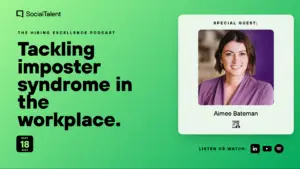
Tackling imposter syndrome in the workplace | with Aimee Bateman
Imposter syndrome isn't a weakness—it's a marker of high achievement. Aimee Bateman reveals how leaders can reframe self-doubt as courage, spot it in teams, and turn it into competitive advantage.
 Johnny CampbellHost · Co-founder & CEO, SocialTalent
What you'll learn
Reframe imposter syndrome as proof you're a high achiever, not a flaw
Separate self-doubt from imposter syndrome to apply the right fix
Build a brag file of past wins to counter imposter-syndrome moments
Spot missed deadlines and perfectionism as signs of hidden imposter syndrome
00:00
--:--
Episode notes
Episode key takeaways
Self-doubt and imposter syndrome are distinct. Self-doubt is normal when you're doing something for the first time; imposter syndrome persists even after a thousand successful iterations. Understanding which one you're experiencing unlocks different strategies: courage and repetition work for self-doubt, but imposter syndrome requires deeper emotional work rooted in genetics, gender biology (serotonin levels), and childhood emotional development.
Courage, not confidence, is the actionable lever. Confidence only comes from experience, but courage—doing something despite fear—is available right now. The data backs this: people regret inaction twice as much as failed action, making the courage to try the better bet every time.
Leaders spot imposter syndrome in two behavioural patterns: perfectionism (work takes four hours instead of one because it's never quite ready) and procrastination (avoidance masquerading as laziness). Both stem from caring too much, not too little. Recognising this distinction transforms how you support high-potential team members who are quietly self-sabotaging.
A brag file—screenshots of praise, testimonials, and past wins—becomes the antidote. When imposter syndrome strikes, it's not a pep talk you need; it's evidence. Aimee keeps hers on her phone and laptop, sorted by domain (public speaking, for instance), and pulls it in moments of doubt to remind herself of what the world already knows.
Good to know
Frequently asked questions
The quick answers behind this episode.
What's the difference between self-doubt and imposter syndrome? +
Self-doubt is normal when tackling something new—you haven’t done it before, so questioning your capability makes sense. Imposter syndrome persists even after repeated success; you’ve done it a thousand times, yet still feel like a fraud. Both are valid, but they require different remedies. Self-doubt yields to courage and repetition; imposter syndrome requires understanding its root causes.
How can leaders identify imposter syndrome in their teams? +
Watch for two patterns: perfectionism (tasks take far longer than necessary because work never feels ready) and procrastination (missed deadlines or avoidance, not from apathy but from fear). Both signal someone who cares deeply but is self-sabotaging. Sit down with them, acknowledge the pattern, and help them build a brag file of past wins to anchor their confidence.
Why do women experience imposter syndrome more than men? +
Research links imposter syndrome to serotonin levels; women produce roughly 52% less serotonin than men, which may be a biological factor. Additionally, women and people from marginalised backgrounds often have fewer past successes to draw on when doubt strikes, making it harder to build the evidence file needed to counter fraudulent feelings. Context and biology both play a role.
Can imposter syndrome ever be fully cured? +
No. Imposter syndrome doesn’t go away; it’s managed. The goal is to make friends with it—to recognise it as your inner voice trying to keep you safe, then act anyway. Over time, you build resilience and a brag file that makes the feeling easier to navigate, but expecting it to vanish entirely sets you up for disappointment.
What's the connection between imposter syndrome and high achievement? +
Imposter syndrome is almost exclusively experienced by high achievers. If you’re feeling fraudulent, the odds are strong you’re already performing at a level that justifies your role. The feeling isn’t evidence of inadequacy; it’s evidence of ambition and standards. Reframing it as a superpower—a sign you’re in the 70% club of driven professionals—flips the narrative from shame to power.