Two years of remote work data isn't enough to declare winners. Social capital built over decades masked what remote work broke; leadership gaps that existed before became more damaging when distributed. The real lesson: social capital can be built in any environment—office, hybrid, or fully remote—but it requires intentional effort and strong leadership to sustain it.
The Hiring Excellence Podcast · Episode 99
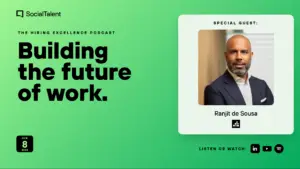
Building the future of work | with Ranjit de Sousa
The pandemic accelerated workforce trends that were already underway—but we still lack data on what actually works. Ranjit de Sousa explores the real problems CHROs must solve: purpose, tech stack strategy, and leadership at scale.
 Johnny CampbellHost · Co-founder & CEO, SocialTalent
What you'll learn
Avoid claiming any office policy is proven with only two years of data
Pilot new HR technology in focused pockets before committing budget at scale
Define company purpose as the concrete problem you solve for customers
Build leadership around coaching, collaboration, culture, community and the customer
00:00
--:--
Episode notes
Episode key takeaways
The skills gap isn't new; the pandemic simply accelerated it. Market cycles now move so fast that top-down strategy fails. Organizations must decentralize decision-making to frontline leaders, and those leaders need the right skills to move at speed. Technology democratizes learning, but only if you first know what skills you actually need and what environment you can offer to attract people.
Ranjit argues that CPOs should experiment, not prescribe. Instead of betting the budget on three or four enterprise platforms, run controlled pilots in specific departments or geographies. Test reskilling tools in one division, employee listening software in a post-acquisition team. This approach surfaces what actually works before you lock in at scale.
Purpose isn't about saving the planet—it's about the specific problem your company solves. Google organizes information. Patagonia fixes the world. Both work because they're clear and consistent. When 60% of your workforce joined post-pandemic and never built in-person social capital, articulating this problem becomes your retention lever.
Good leadership rests on five pillars: coaching individuals, enabling collaboration, defining culture, building community, and centering the customer. Empathy alone isn't enough; compassion—actually helping people solve problems—is what separates sustainable leaders from those who burn out their teams.
Good to know
Frequently asked questions
The quick answers behind this episode.
Should we mandate return to office or stay fully remote? +
The honest answer: we don’t have enough data yet. Two years of remote work relied on social capital built over decades in offices. What we know is that social capital and strong leadership matter more than location. SaaS companies prove distributed works; large enterprises with established teams may benefit from hybrid. The setup depends on your industry, your people, and your leadership capability—not a one-size mandate.
How do we close the skills gap when there's talent shortage everywhere? +
Technology can help on two fronts: democratize learning through accessible, on-demand upskilling platforms, and improve matching between supply and demand. But technology alone fails. First, diagnose what skills you actually need. Second, understand what environment attracts people—salary, culture, purpose. Then layer in the right tools. Without clarity on those fundamentals, even the best learning platform won’t solve the problem.
What tech should we buy first—ATS, learning platform, employee listening? +
Don’t prescribe top-down. Instead, identify one or two focused areas where you can experiment: a department with skills depletion, a post-acquisition team, a high-attrition cohort. Test tools in that controlled space, measure what works, then scale. This prevents lock-in to platforms that may become obsolete and gives you real data on ROI before you commit enterprise-wide.
Who should own the people tech stack in a large organization? +
Few companies have this role, but they should. A People Ops leader who owns the entire employee experience—not IT, not HR alone—can orchestrate the stack, minimize overlap, and ensure clarity on which tool solves which problem. Without this orchestration, employees end up using Slack, email, and three project management tools in parallel, creating friction and wasting time.
How do we build culture and purpose when most hires are remote? +
Start with the core problem your company solves for customers. That problem statement informs purpose and culture. When 60% of your workforce joined remotely, they never experienced in-person social capital, so you must be intentional: clarify the problem, communicate it consistently, and invest in leadership that reinforces it. Purpose isn’t HR-owned; it’s CEO-owned and lived through every leader’s decisions.