Bias enters hiring through gut feeling, not malice. Comments like 'they wore a baseball hat to the interview' or 'they're overqualified' mask deeper assumptions about fit, age, or background. The solution isn't awareness alone—it's process design that removes decision-making shortcuts.
The Hiring Excellence Podcast · Episode 102
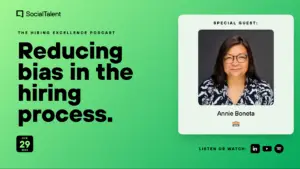
Reducing bias in the hiring process | with Annie Boneta
Knowing you have bias and acting on it are two different things. Annie Boneta explores how blind resumes, diverse interview panels, and data audits create fairer hiring processes—and why technology alone won't solve discrimination.
 Johnny CampbellHost · Co-founder & CEO, SocialTalent
What you'll learn
Recognize cloaked language hiring managers use to disguise unconscious bias
Avoid assuming laid-off candidates are automatically weaker performers
Use early technical tests instead of resumes to screen out pedigree bias
Audit panel composition since a single token hire rarely gets selected
00:00
--:--
Episode notes
Episode key takeaways
Blind resume screening works, but only as a first step. Removing names, schools, and company pedigree helps interviewers focus on achievements rather than pattern-matching. Technical assessments early in the funnel cast an even wider net by letting candidates prove capability before resume bias kicks in.
Annie emphasizes that vulnerability builds trust with hiring managers. When recruiters share their own stories—like lacking a degree but succeeding in TA—managers become more open to reconsidering their hiring bars. This relationship-first approach is how bias gets challenged in real time, not in training slides.
Layoffs trigger a new bias: assuming laid-off candidates are low performers. In reality, entire teams get cut for cost or restructuring. Recruiters who know the context can reframe the narrative and prevent hiring managers from screening out strong talent based on a false signal.
AI and automation can embed bias at scale if built on skewed data. Amazon's scrapped hiring algorithm discriminated against women because it learned from ten years of existing hiring patterns. Audits—measuring outcomes pre- and post-implementation—are non-negotiable, not optional.
Good to know
Frequently asked questions
The quick answers behind this episode.
Does blind resume screening actually get candidates hired? +
Blind resumes help interviewers focus on achievements rather than pedigree, making it easier for underrepresented candidates to advance past screening. However, it’s only effective as part of a broader process. Pairing blind resumes with early technical assessments removes even more bias by letting capability speak before background does.
How do I push back on a hiring manager's biased feedback? +
Build trust first. When managers feel safe, they’ll voice biases directly—like concerns about pregnancy or education level. Use that opening to ask clarifying questions: ‘Why does that matter to the role?’ Share relevant counterexamples or your own story. The goal is to expand their definition of ‘great,’ not shame them.
What's the 'theory of onlys' in hiring panels? +
Having one woman on a panel of two men doesn’t guarantee her voice carries weight. Data shows the chances of her being hired can still be zero. Diverse panels only reduce bias if the panel is genuinely balanced and the hiring criteria are clear and aligned before interviews begin.
Can AI hiring tools discriminate? +
Yes. If an algorithm is trained on historical hiring data or benchmarked against a small group of ‘ideal’ employees, it learns and amplifies existing biases. Regular audits measuring outcomes pre- and post-implementation are essential. Transparency about what the tool is measuring—and why—is non-negotiable.
How should recruiters frame candidates who were laid off? +
Layoffs rarely signal poor performance; they often reflect cost-cutting or restructuring. Reframe the narrative: ‘This entire group was affected’ or ‘They were among the highest performers.’ Knowing the context lets you counter the bias that laid-off candidates are bottom-quartile talent and help managers see the opportunity.