Yoga classes and fruit bowls have their place, but they're not the solution to burnout. The deeper work involves helping employees find meaning in their roles, feel empowered to shape their work environment, and develop the mindset and coping mechanisms to navigate change on their own terms.
The Hiring Excellence Podcast · Episode 110
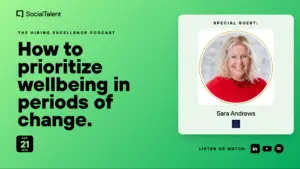
How to prioritize wellbeing in periods of change | with Sara Andrews
Hybrid work, economic uncertainty, and rapid change are testing employee resilience at scale. Sara Andrews, Chief People Officer at Acacian Group, shares how leaders can move beyond wellness initiatives to build cultures where wellbeing is genuinely owned by employees and managers alike.
 Johnny CampbellHost · Co-founder & CEO, SocialTalent
What you'll learn
Build multiple safe channels beyond managers for employees to discuss personal struggles
Recognize that wellness perks alone cannot replace meaning and connection at work
Avoid rewarding late nights and weekends as signals of dedication
Track well-being progress by blending survey data, feedback, and turnover
00:00
--:--
Episode notes
Episode key takeaways
One-size-fits-all wellbeing doesn't work. Different people need different support at different times—some want to stay connected on holiday, others need complete disconnection. The shift from 'fair' (identical treatment) to 'equitable' (tailored to individual circumstance) is where managers need coaching.
Mental health first aiders and wellbeing champions should be volunteers, not appointed. Sara's organization was overwhelmed with volunteers and captures them during onboarding, creating a distributed, psychologically safe network that employees trust precisely because it sits outside the direct manager relationship.
Talent now leads with wellbeing, not salary. In competitive markets with skill shortages, candidates are testing whether organizations genuinely prioritize care—and they'll walk if the culture doesn't match the promise. Turnover costs and time-to-competence make this a quantifiable business driver.
Shareholders and investors are embedding ESG metrics into investment decisions, adding external pressure to embed wellbeing into organizational fabric rather than treating it as a checkbox exercise. This convergence of talent demand and investor expectation is reshaping how leaders think about culture.
Good to know
Frequently asked questions
The quick answers behind this episode.
How do you identify mental health first aiders and wellbeing champions? +
Don’t appoint them—invite volunteers. Capture interest during onboarding and provide training to anyone who steps forward. This approach builds genuine buy-in and ensures the role attracts people who are truly passionate about supporting colleagues, not those fulfilling a quota.
What resilience training actually works in the workplace? +
A mix of approaches: facilitated workshops in psychologically safe groups (6–8 people), external coaching focused on mindset and coping mechanisms, and peer learning. The key is variety—not everyone engages the same way. Training works best when it helps people recognize their own triggers and build a personal toolkit.
How do you stop rewarding burnout culture? +
Make it explicit: leaders should actively encourage teams to log off and respect boundaries. Recognize that midnight oil is acceptable for one-off business needs, not the norm. Reward and recognize support functions equally with sales teams. Coach managers on equity—different people need different flexibility—rather than enforcing identical policies.
How do you measure if wellbeing initiatives are working? +
Use multiple indicators: annual engagement surveys with dedicated wellbeing questions, mid-year pulse surveys capturing verbatim feedback, turnover rates, and overall business performance. Don’t chase ROI per initiative; instead, blend these signals to understand whether the organization is moving in the right direction.
Why should investors care about employee wellbeing? +
ESG metrics are now central to investment decisions. Shareholders expect organizations to be responsible and sustainable, which directly ties to talent retention, culture, and long-term value creation. Wellbeing is no longer a nice-to-have—it’s a material business and investment narrative.