The gap between what you advertise and what candidates experience on day one is now a liability, not a marketing problem. A decade ago, organizations focused heavily on attraction campaigns without considering that hired candidates would immediately discover misalignment—leading to early exits when organizational DNA rejected them. Today's winning approach links employer branding directly to employee experience, ensuring external claims match internal reality.
The Hiring Excellence Podcast · Episode 116
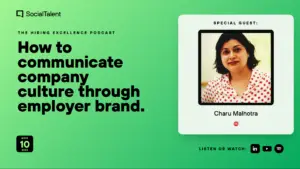
How to communicate company culture through employer brand | with Charu Malhotra
Employer branding has evolved from marketing what you have to influencing what you should become. Charu Malhotra explores how to align external messaging with internal reality, and why candidates now demand authenticity over polish.
 Johnny CampbellHost · Co-founder & CEO, SocialTalent
What you'll learn
Align internal culture with external employer brand promises
Question vague hybrid claims candidates now scrutinize on job ads
Avoid generic advocacy content that makes employees sound identical
Share warts-and-all stories instead of polished diversity messaging
00:00
--:--
Episode notes
Episode key takeaways
Segmentation has replaced the monolithic EVP. One global value proposition no longer works when employees in Indonesia, India, and Poland experience the same company culture vastly differently. Rather than spending six to twelve months on a single EVP, organizations should think in terms of value proposition pillars and messaging that can be activated locally and adapted by region.
Leadership visibility is now table stakes. Candidates increasingly research executives on YouTube and LinkedIn before interviews, looking for authentic positions on ESG, climate, and company direction—not corporate talking points. The absence of visible leadership creates a vacuum that candidates fill with their own (often negative) conclusions.
Employee advocacy only works when it's personal, not scripted. Charu emphasizes that when 100 employees post identical copy with the same buzzwords, it reads as inauthentic and backfires. Effective advocacy gives employees guardrails and hints, not scripts—letting subsea engineers talk about drills they've built, not brand pillars.
Diversity representation in recruitment content requires honest messaging, not casting. Showing significantly more people of color than actually exist in your workforce reads as false advertising and damages trust. The ethical approach: represent your best self authentically, acknowledge gaps openly, and articulate what you're doing to change—not what you wish you were.
Good to know
Frequently asked questions
The quick answers behind this episode.
How do you align employer brand messaging with actual company culture? +
Start by listening—run cultural audits, social listening, and focus groups with employees and candidates. Identify gaps between messaging and reality. Then position yourself as a change agent: communicate what you’re hearing, what isn’t working, and what you’re doing to fix it. Candidates respect honesty about challenges far more than claims of perfection.
What does 'hybrid work' really mean to candidates now? +
Candidates are asking forensic questions about what hybrid actually means—specific days in office, flexibility, or something else. Simply posting ‘hybrid’ on a job ad is no longer sufficient. Be explicit about expectations, because vague language signals either confusion or dishonesty, both of which damage your employer brand.
Should recruitment marketing influence company culture, or just communicate it? +
It should do both. Employer branding professionals sit at the intersection of marketing and product (culture). They should have a voice in cultural audits and organizational design, flagging retention risks, progression gaps, and policy issues they hear from candidates. This positions TA as a strategic partner, not just a communications function.
How do you scale employee advocacy without it becoming corporate clones? +
Give employees freedom and guardrails, not scripts. Provide hints, tips, and context on why sharing matters—but let them talk about what they’re passionate about. Pilot with smaller groups first. The magic happens when a subsea engineer’s authentic voice reaches peers at competing firms, not when 100 employees recite brand pillars.
What's the risk of over-representing underrepresented groups in recruitment content? +
It creates an emotional tax on those employees, who are often asked to appear in every diversity video while also heading ERGs and recruiting—all unpaid, on top of their day job. Additionally, if representation in content far exceeds reality, new hires experience immediate dissonance. Show your best authentic self; don’t rent a wardrobe you don’t own.