Saying yes to everything stems from hidden commitments, not generosity. Fear of being overlooked, judged as difficult, or deemed incompetent keeps people trapped in a cycle of overcommitment. Naming these beliefs—not just the behavior—is where real change begins.
The Hiring Excellence Podcast · Episode 126
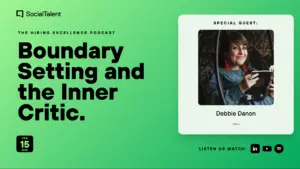
Boundary Setting and the Inner Critic | with Debbie Danon
Boundary-setting and managing your inner critic aren't soft skills—they're foundational to team performance. Debbie Danon explores how leaders can build thriving teams by addressing the hidden beliefs that drive poor decisions.
 Johnny CampbellHost · Co-founder & CEO, SocialTalent
What you'll learn
Identify whether your default boundary style is porous or rigid
Delay your answer with a stock phrase instead of reacting instantly
Recognize the inner critic as a safety-seeking part not literal truth
Notice the physical sensations that signal your boundaries are being crossed
00:00
--:--
Episode notes
Episode key takeaways
Healthy boundaries live on a spectrum between porous (always yes) and rigid (always no). The goal is the middle: honest capacity assessment, counter-offers, and time to think. Stock phrases like 'Can I get back to you?' or 'I'm maxed—would next week work?' create space for better decisions.
Visibility of priorities and workload across the team transforms boundary-setting from individual struggle to collective practice. When everyone shares their time percentages in meetings, descoping becomes possible—and necessary. If everyone's at 100% all the time, the system isn't optimized.
The inner critic isn't the enemy; it's a protective part trying to keep you safe from perceived harm. Distinguishing it from your authentic self—treating it like a character in a meeting rather than the truth—lets you bring other sources of wisdom (experience, champions, courage) to the table.
Marginalized identities face amplified inner critics shaped by systemic constraints, not personal weakness. Leaders who build language around this—and believe colleagues when their experience differs—unlock performance and remove barriers that brain-alone solutions never will.
Good to know
Frequently asked questions
The quick answers behind this episode.
How do I set boundaries without being seen as unhelpful or uncommitted? +
Reframe boundaries as protecting your capacity to deliver on priorities, not rejecting help. Use phrases like ‘I’d love to help—I’m currently maxed. Would next week work?’ or ‘Let me check my capacity and get back to you.’ This signals responsiveness while creating space for honest assessment.
What's the difference between prioritization and descoping? +
Prioritization ranks tasks 1–10 and accepts that 8–10 won’t get done. Descoping goes further: it removes work entirely because capacity doesn’t exist. In a world of limited hours, both are necessary. Descoping acknowledges that not everything can be done well, even with perfect prioritization.
How do I manage my inner critic when facing a challenging task? +
First, notice what happens in your body—tension, constriction, butterflies. Name it: ‘That’s my inner critic, not me.’ Then bring in other voices: What would a champion say? What have I done before that was scary but worked? Treat the critic as a protective part, not the truth.
Why do some leaders dismiss boundary-setting and inner critic work as 'not business'? +
They often have a hidden commitment to the status quo—a belief that success is purely merit-based and that discussing systemic barriers threatens that narrative. Reframing this as unleashing potential, reducing turnover, and avoiding costly lawsuits can shift perspective from threat to opportunity.
How should I approach inner critic conversations with colleagues from marginalized backgrounds? +
Believe their experience even if it differs from yours. Systemic constraints shape inner critics differently across identities—women, Black colleagues, queer colleagues, disabled colleagues face distinct pressures. Ask how they’re perceiving a situation, listen without defensiveness, and address barriers in the culture, not just the individual.