The hiring plan is roughly 50% accurate, yet most organizations treat it as gospel and hand it to TA with no strategic conversation. Anne advocates for a diagnostic approach: before going to market, ask what the business is actually trying to achieve, where internal capability gaps exist, and whether the answer is really external hiring or something else entirely.
The Hiring Excellence Podcast · Episode 131
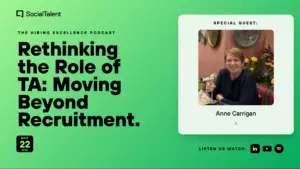
Rethinking the Role of TA: Moving Beyond Recruitment | with Anne Carrigan
Talent acquisition has spent two decades as a transactional hiring function. Anne Carrigan argues it's time to reframe TA as a strategic business partner—one that advises on retention, internal mobility, and capability building alongside external hiring.
 Johnny CampbellHost · Co-founder & CEO, SocialTalent
What you'll learn
Diagnose capability gaps before assuming every vacancy needs external recruiting
Apply the build, buy, borrow, and bounce approach to fill vacancies
Build a talent map that reveals skills and gaps across the organization
Find a sponsor before attempting an organization-wide talent function overhaul
00:00
--:--
Episode notes
Episode key takeaways
Siloed HR functions—TA, L&D, organizational development—often work at cross-purposes. One organization explicitly told L&D that TA couldn't 'poach' staff for internal moves, while simultaneously losing 20% of employees due to lack of development opportunities. Breaking those walls requires TA to sit in the middle of the table, not behind an HR business partner.
The build-buy-borrow-bounce framework offers a practical way to scale this thinking. For every role, ask: Are we building capability internally? Buying it externally? Borrowing it via contractors or internal stretch assignments? Or is this a performance issue we're hiring around? This conversation doesn't require new technology—it requires rigor and sponsorship.
Talent mapping—documenting skills, readiness, flight risk, and development potential across a business unit—creates social proof. Once one team sees the value, others demand it. This low-risk entry point sidesteps the need for a top-down mandate and builds momentum for broader integration.
Individual contributors can start today by listening to employee pulse surveys, understanding what development opportunities people want, and bringing market insights to hiring managers. Reframe the pitch from 'I'll fill this role' to 'Did you know 60% of our people are looking to move internally? Could this be an opportunity for them?'
Good to know
Frequently asked questions
The quick answers behind this episode.
What questions should TA ask before opening a requisition? +
Start with strategy: What is the business trying to achieve? Growth, new markets, new skills? Then explore capability: Why can’t we fill this internally, and what gap exists? Finally, ask about team dynamics: What makes someone successful here, and is that a skill we can develop or must we hire? This diagnostic approach prevents rushing to market prematurely.
How do you scale talent business partner conversations across hundreds of hiring managers? +
Bring rigor, not complexity. Use the build-buy-borrow-bounce framework consistently so managers recognize the pattern. Start with one business unit, create a talent map, and let social proof drive adoption. Sponsors in the business become advocates. The goal is rhythm, not perfection—managers learn to ask the same questions every time.
What's blocking organizations from integrating TA, L&D, and organizational development? +
Lack of organizational design skill, manager resistance to internal mobility (fear of losing talent), and siloed budget accountability. But the biggest blocker is TA not having a seat at strategic conversations. Without a sponsor at the executive level and time carved out for dialogue, TA remains transactional. Finding one sponsor and proving value in one area breaks the cycle.
How does internal mobility improve diversity and inclusion outcomes? +
Data reveals patterns: one organization found every woman who left was backfilled by a man, yet women were leaving due to lack of development. TA can arm hiring managers with diversity insights from employee pulse surveys, show career paths for underrepresented groups, and actively facilitate internal moves. This turns TA into a lever for equitable opportunity.
What's the first step for a TA leader wanting to shift toward this model? +
Get to know your L&D and talent development teams first. Understand what’s on their radar. Then find one sponsor—a hiring manager or business leader who wants to have a different conversation. Start small, create a talent map for one area, and let success spread organically. Don’t wait for a business case or top-down mandate.