Employees stay 41% longer at companies with robust internal hiring, yet most organizations remain externally fixated. Giorgio's organization flipped this by embedding manager accountability for development and investing more in L&D than talent acquisition—a structural signal that internal growth is the default strategy.
The Hiring Excellence Podcast · Episode 134
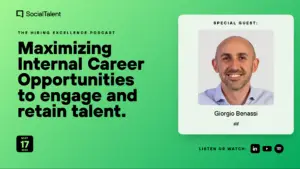
Maximizing Internal Career Opportunities to engage and retain talent | with Giorgio Benassi
H&M Group's Giorgio Benassi shares how 150,000-person retail organization maintains 70–90% internal promotion at management levels while avoiding insularity. Learn the skills-based visibility model, cultural barriers, and AI's role in scaling career pathways.
 Johnny CampbellHost · Co-founder & CEO, SocialTalent
What you'll learn
Balance internal development with outside hires to avoid an inward-looking culture
Build visibility tools so career moves don't depend on informal manager networks
Use generative AI to map skills faster than years of manual meetings
Reduce a single hiring manager's unilateral control over internal moves
00:00
--:--
Episode notes
Episode key takeaways
Too much internal hiring creates blind spots. After decades of promoting from within, H&M realized it had missed digital transformation trends because the organization became inward-looking, comparing itself to itself rather than the market. The lesson: internal mobility and external perspective aren't opposites—they're complementary.
Visibility, not job titles, unlocks career movement at scale. Moving from manager-driven mobility to a skills-based, platform-enabled model lets 150,000 colleagues see competencies the organization prioritizes, understand what development paths exist, and make informed career decisions without relying on their manager's network or knowledge.
Horizontal gig work and project-based opportunities matter as much as promotions in constrained growth environments. When traditional advancement slows, internal projects, cross-functional assignments, and skill-building opportunities become the currency of engagement—but only if they're visible and fairly allocated, not hidden in informal networks.
Generative AI solves the taxonomy problem, not the culture problem. Building a skills framework traditionally takes 3–4 years of stakeholder meetings; AI can generate one in weeks. This frees leaders to focus on the harder work: changing deeply embedded beliefs about heroic management and formal processes as 'red tape.'
Good to know
Frequently asked questions
The quick answers behind this episode.
What percentage of H&M roles are filled internally versus externally? +
Office roles split roughly 50/50 internal-external. Store and warehouse hiring skews heavily external (90,000 hires yearly, mostly temporary/part-time). Management layers shift dramatically: first-level managers are ~70% internal promotion; senior leadership reaches 90% internal. The split reflects business need and growth phase.
How do you prevent internal-only hiring from creating organizational blind spots? +
Deliberately inject external hires in strategic areas—especially where the organization has fallen behind market trends. Digital transformation required heavy external hiring to bring fresh perspectives. The key is blending: pair long-tenured internal talent (who understand business context) with external experts (who bring different systems and approaches) on the same teams.
What's the biggest cultural barrier to scaling internal mobility? +
Heroic manager-centric leadership. Senior leaders grew up in a system where managers personally guided careers and made all decisions. Formalizing mobility through platforms and processes feels like ‘red tape’ to them. Overcoming this requires quick wins—showing that technology enables rather than replace leadership—and patience, since this cohort experienced the ‘golden era’ of abundant opportunities.
How can retail skills be mapped and matched to office roles? +
Move from job-title-centric to competency-centric visibility. A store associate may have project management, conflict resolution, and training skills transferable to HR or operations roles. Skills-based platforms and AI-driven matching help surface these hidden capabilities at scale. Alumni programs and early-career tracking also help identify talent (e.g., students working part-time who later become engineers).
What role does AI play in solving internal mobility at scale? +
AI accelerates skills taxonomy building from years to weeks, bypassing lengthy stakeholder alignment. It can map competencies across 150,000 employees and 90,000 annual hires, surfacing patterns humans would miss. This frees HR to focus on the cultural and process work—the harder, slower part of transformation.