Training alone doesn't move the needle. The real gap lies in application: employees need clear milestones, leadership feedback, and structured support to translate learning into measurable skill improvement. Without that scaffolding, even well-designed programs fail to stick.
The Hiring Excellence Podcast · Episode 139
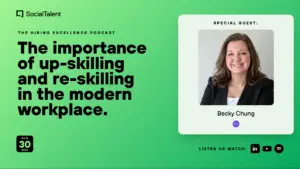
The importance of up-skilling and re-skilling in the modern workplace | with Becky Chung
Training is a moment, not a solution. Becky Chung shares how Cielo scaled learning programs across 3,000 employees in 140 countries—and proved that structured upskilling drives engagement, retention, and performance.
 Johnny CampbellHost · Co-founder & CEO, SocialTalent
What you'll learn
Treat training as a single moment, not the whole learning solution
Add clear structure and deadlines even to flexible self-directed programs
Wait three to six months before measuring real performance impact of training
Apply an eighty-twenty split between general content and local customization
00:00
--:--
Episode notes
Episode key takeaways
Self-directed learning sounds ideal but backfires in practice. Pilot feedback revealed that even top performers crave structure—deadlines, clear success metrics, and visibility into progress. Flexibility matters, but so does accountability.
Becky Chung's team measures impact across multiple dimensions: engagement scores, turnover rates, performance reviews, and internal promotion velocity. Programs tracked for a full year show learners are more engaged, leaving at lower rates, and advancing faster than peers who skipped development.
The 80/20 rule scales globally. Eighty percent of content can be standardized; twenty percent adapts to role, language, and learning style. This balance keeps programs digestible without sacrificing relevance across 140 countries.
Leadership behavior is the multiplier. Courageous, compassionate managers who give candid feedback, set clear development plans, and meet weekly with direct reports create the conditions where learning actually translates to performance—not just completion rates.
Good to know
Frequently asked questions
The quick answers behind this episode.
How do you measure ROI on learning programs? +
Start with early indicators: learner engagement and self-reported development. Then wait 3–6 months and compare program participants to non-participants on performance metrics—offers produced, client satisfaction, candidate experience, and productivity. Look at multiple measures, not just one, to account for variables outside training.
What does a modern upskilling program look like? +
Multifaceted delivery (live, e-learning, microlearning), clear milestones and success metrics, structured leadership support, and ongoing feedback loops. Partner with experts for specialized content; build internal teams for business-specific training. Avoid one-off classroom sessions; embed learning into workflows.
How do you balance flexibility with structure in self-directed learning? +
Provide clear deadlines and milestones while allowing choice in *how* learners engage. Offer multiple formats (video, text, interactive) and pacing options. Set explicit expectations upfront about what success looks like and how progress will be measured—this clarity drives completion and application.
What leadership behaviors drive successful upskilling? +
Weekly one-on-ones, monthly team meetings, quarterly development conversations, and individual development plans for every direct report. Leaders must give candid feedback, explain *why* a skill matters, and help employees connect learning to real work. Compassion + courage = the formula.
How does generative AI change learning delivery? +
AI can summarize content, surface skill-transfer opportunities, and auto-generate multiple formats (45-second clips, 5-minute summaries, 15-minute deep dives) from one source. This enables truly personalized, consumable learning at scale—matching how people already engage with content on platforms like TikTok.