The recruiter replacement myth misses the real shift. Just as Excel didn't eliminate accountants—it freed them from manual calculation to do analysis and strategy—AI will automate the transactional screening, Boolean search, and CV-passing work that has never been true recruiting anyway. The job changes, but the role expands for those who lean into advisory.
The Hiring Excellence Podcast · Episode 146
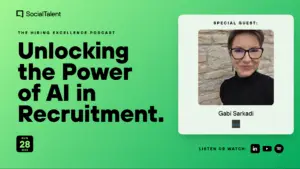
Unlocking the Power of AI in Recruitment with José Kadlec and Gabi Sarkadi
José Kadlec and Gabi Sarkadi explore how AI transforms recruitment from a processing function into strategic advisory work. Learn why the accountant-and-Excel analogy matters, and how to use co-pilots without losing the human edge.
 Johnny CampbellHost · Co-founder & CEO, SocialTalent
What you'll learn
Use AI co-pilots to execute recruiting tasks fast without replacing your judgment
Distinguish enterprise AI platforms from personal AI co-pilots you control directly
Shift from manual CV processing toward becoming a trusted advisor to candidates
Apply deliberate practice with real feedback loops to build lasting recruiting skills
00:00
--:--
Episode notes
Episode key takeaways
Co-pilots like ChatGPT, Gemini, and Claude work best as a PhD assistant sitting in your tab, not as a replacement. Use them to generate certification lists, sourcing synonyms, interview prep frameworks, or email drafts—then validate and refine. The speed and volume of support scales your capacity without removing your judgment from the loop.
Culture fit and soft-skill assessment are technically automatable but practically risky. New voice-to-voice models (GPT-4o) can detect tone, pacing, and emotional nuance beyond words alone, and body language analysis is improving. However, regulation, candidate experience, and employer brand often override what's technically possible—premium employers will differentiate by keeping humans in the loop for senior roles.
The real skill gap isn't AI literacy; it's the ability to ask good questions and stay inquisitive. Recruiters who experiment, who ask 'what if,' who dig into industry context through conversation rather than memorisation—those people adapt fastest to any tool. Lifelong learning and curiosity matter more than formal certification.
Recruitment education is broken because practice and feedback don't scale. Watching a video or attending a talk isn't learning; it's exposure. Real learning requires deliberate practice with feedback—the same loop elite athletes use. AI simulators (e.g., role-playing a demanding hiring manager via ChatGPT) finally make this scalable, but most training still skips this step.
Good to know
Frequently asked questions
The quick answers behind this episode.
Will AI replace recruiters? +
Not in the near term, but the role will transform. Transactional tasks—Boolean search, CV screening, scheduling—will automate. Recruiters who evolve into trusted advisors for candidates and hiring managers, who bring market insights and process design, will thrive. Those who only process paperwork will face pressure. The timeline is years, not months, because scale requires data and regulation.
How should recruiters start using AI today? +
Start with a co-pilot (ChatGPT, Gemini, Claude) for specific tasks: generate sourcing synonyms, list IT certifications, draft outreach templates, or simulate a hiring manager interview for practice. Treat it as a research and drafting assistant, not a decision-maker. Validate outputs, add your judgment, and iterate. Voice-based interaction is especially effective for recruiters on the move.
What skills will matter most as AI automates recruiting tasks? +
Trusted advisor skills: understanding your candidate market deeply, giving hiring managers strategic counsel on role design and team structure, and building credible partnerships with talent. Industry knowledge, curiosity, and the ability to ask probing questions matter more than tool proficiency. Soft skills—coaching, negotiation, relationship-building—become the differentiator.
Can AI assess culture fit better than humans? +
Technically, yes—new models analyse tone, pacing, body language, and background context. But regulation, candidate experience, and employer brand often override capability. Candidates resent AI screening for senior roles; premium employers will compete by keeping humans in the loop. Cost and acceptance, not just technology, determine adoption.
What's the biggest gap in recruiter training today? +
Practice and feedback don’t scale. Most training is passive—videos, talks, e-learning—without deliberate practice loops. Real learning requires doing the skill, getting feedback, and repeating. AI simulators (e.g., role-playing with ChatGPT) now make this scalable, but most programmes still skip this step, leaving recruiters unprepared for real scenarios.