The unsexy work comes first. Before chasing quality or cost targets, map your end-to-end process step by step—from career site through day one—and measure each stage. Most TA leaders skip this because it's not the shiny stuff, but it's where results actually live.
The Hiring Excellence Podcast · Episode 152
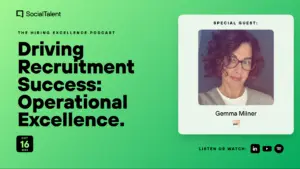
Driving Recruitment Success: Operational Excellence with PwC's Gemma Milner
Gemma Milner, Head of Talent Acquisition at PwC, breaks down why most TA teams skip the unglamorous work of understanding their own processes—and why that's the real lever for quality, speed, and cost. Data-led, detail-obsessed, and built for scale.
 Johnny CampbellHost · Co-founder & CEO, SocialTalent
What you'll learn
Map what your recruiting process looks like end to end before changing it
Investigate any data point that looks unusually good or oddly off
Cut process steps that don't affect quality without hurting candidate experience
Question a suspiciously low time-to-hire metric before trusting it as a win
00:00
--:--
Episode notes
Episode key takeaways
Data tells you what to question, not what to do. Gemma emphasizes that reliable, clean data is the foundation; the real skill is asking why the numbers look the way they do. If you can't explain a metric back to a hiring manager without fully understanding each step, that's the metric you need to dig into.
Remove steps that don't filter. During COVID hiring surges, one analysis revealed assessment stages where the same percentage of candidates advanced regardless of performance—pure friction with no signal. Removing those steps while enhancing candidate interaction with screeners cut time-to-offer significantly without sacrificing quality.
AI enhances process; it doesn't replace understanding. Technology amplifies operational excellence but only after you've locked down what you're trying to achieve and where humans add irreplaceable value. In professional services hiring, that human touch remains central to culture fit and engagement.
Behavioral change is harder than tech. Getting teams to own operational excellence means showing them what's in it for them—clearer data on their own impact, tools to be SMEs, and real involvement in change decisions. Top-down mandates feel like being done to; co-designed improvements feel like ownership.
Good to know
Frequently asked questions
The quick answers behind this episode.
How do you identify inefficiencies in your recruiting process? +
Start with data that looks unusual or doesn’t make intuitive sense. If something appears odd, pull the thread: ask why that metric exists, what’s driving it, and whether you can explain it fully. Numbers that seem too good (e.g., suspiciously low time-to-hire) often hide behavioral risks worth investigating.
What's the first step to implementing operational excellence in TA? +
Map your current state end-to-end before optimizing anything. Understand what’s working, what’s not, and where friction exists. Assign a measure to each step—time, cost, or ROI—so you can see the full picture and prioritize improvements against business strategy, not guesswork.
How do you measure if a recruiting step is actually valuable? +
Look at the filtering power: if 50% of candidates are eliminated at a stage, it’s valuable. If only 2% drop out, the effort and candidate friction aren’t justified by the signal gained. Remove low-signal steps and reallocate that time to higher-touch, higher-value interactions.
Where does AI fit into operational excellence in recruiting? +
AI works best after you’ve nailed your baseline processes. Use it to automate admin, research, and transactional tasks so humans can focus on real engagement and culture fit. The approach is AI-powered, human-led—technology enhances the process, not replaces the understanding of what you’re trying to achieve.
How do you get your team to buy into process improvements? +
Show them what’s in it for them: clearer data on their impact, tools to be subject-matter experts, and real involvement in designing change. Not all change requires full team input, but everyone can be a change agent. Involvement beats top-down mandates every time.