Resumes capture what someone was hired to do in their last role, not what they're capable of doing. The gap between past job titles and future-ready abilities is where most hiring goes wrong, especially as roles transform faster than credentials can keep pace.
The Hiring Excellence Podcast · Episode 175
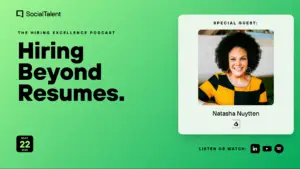
Hiring Beyond Resumes with Natasha Nuytten of Clara
Resumes don't reveal what candidates can actually do. Natasha Nuytten of Clara explains why assessing for learning agility, critical thinking, and resourcefulness—not job titles—predicts success in roles that will change faster than we can predict.
 Johnny CampbellHost · Co-founder & CEO, SocialTalent
What you'll learn
Recognize why resumes reveal only past duties, not true capability
Screen for learning agility and critical thinking over static skill lists
Counter the brain's default bias toward past hiring patterns
Spot skill equivalencies that reveal transferable ability beyond exact matches
00:00
--:--
Episode notes
Episode key takeaways
Five generations now work simultaneously, and by 2030, 55% of the US workforce will be over 55. Assuming younger workers are inherently more AI-native misses the learning agility and adaptability that exist across age groups and can be assessed directly.
Natasha's framework prioritizes critical thinking, learning agility, distance traveled (what you've learned from experience, not just what you've done), resourcefulness, self-efficacy, and anti-fragility. These abilities predict success across roles and are teachable—meaning hiring becomes an investment in development, not just filtering.
A caregiver re-entering the workforce after time out has learned new skills on their growth edge. Rather than penalizing career gaps, organizations should recognize the learning velocity and adaptability those gaps often reveal.
Skill equivalencies matter more than keyword matches. Just as baking soda, club soda, and whipped egg whites solve the same baking problem, different career paths and experiences can deliver the same job capability—but only if you assess for ability, not resume pedigree.
Good to know
Frequently asked questions
The quick answers behind this episode.
How do you assess for learning agility and critical thinking in a hiring process? +
Clara uses a proprietary assessment that presents real-world scenarios tied to the role. Candidates describe how they’d solve problems; there are no wrong answers, but responses reveal patterns in resourcefulness, proactivity, and problem-solving approach. The assessment is designed to be accessible to neurodivergent candidates, avoiding the ambiguity of personality tests.
Should you still require specific credentials or certifications for specialized roles? +
Yes—you still need foundational skill sets for roles like accounting or surgery. The shift is asking: what will change about this job, and where can we ask someone to innovate? Hiring for learning agility and critical thinking alongside credentials creates a workforce ready to use AI and adapt as the role evolves.
How do you prevent bias when moving away from resume-based hiring? +
Systematizing assessment of abilities rather than relying on hiring managers’ intuition reduces bias. When you measure the same competencies across all candidates and reshuffle the entire pool when role needs change, you avoid defaulting to ‘people like us’ and surface candidates you’d otherwise overlook.
What's the difference between assessing abilities and personality tests? +
Ability assessments measure skills like critical thinking and resourcefulness through concrete scenarios; they’re teachable and role-relevant. Personality tests measure emotional traits and are often ambiguous, making them harder for neurodivergent candidates and less predictive of job performance.
How does Clara help with high-volume hiring? +
For roles where you’re hiring multiples of the same position, Clara bubbles up the strongest candidates based on future-ready abilities rather than filtering to the most obvious choices. It also re-engages past applicants when role requirements shift, ensuring you’re searching the full pool equitably.