The NHS functions as a yardstick for the entire UK healthcare market—its pay, conditions, and perception directly shape where clinical talent flows. When NHS conditions improve, private providers face retention pressure; when they decline, talent migrates outward. This dynamic will intensify as public-private partnerships expand under the government's Fit for the Future plan.
The Hiring Excellence Podcast · Episode 192
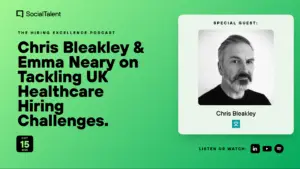
Chris Bleakley & Emma Neary on Tackling UK Healthcare Hiring Challenges
Chris and Emma reveal how NHS policy cascades through private healthcare recruiting, why international nurse hiring has dropped 80%, and the real cost of unfilled clinical roles. A masterclass in sector-specific TA strategy.
 Johnny CampbellHost · Co-founder & CEO, SocialTalent
What you'll learn
Link unfilled clinical shifts directly to rising costs and falling profitability
Grow your own nursing talent pipeline to cut reliance on agency staff
Evaluate any RPO partnership on contract design and leadership alignment
Replace WhatsApp groups and sticky notes with a digital bank shift app
00:00
--:--
Episode notes
Episode key takeaways
International nurse sponsorship has collapsed from routine large-scale hiring to near-zero in 18 months, yet nursing gaps have shrunk to 3–4%—the smallest on record. This isn't a supply win; it reflects lower attrition and stronger retention, masking a finite long-term problem: the UK isn't training enough clinical staff domestically, and reliance on net-exporter countries like India will resurface.
Unfilled clinical vacancies don't sit empty—they trigger overtime cascades that inflate treatment costs, reduce procedure capacity, and compromise care continuity. Emma and Chris track this daily because the commercial and patient-safety stakes are identical: stabilised staffing directly enables both profitability and safer outcomes.
RPO vs. in-house is a false binary. Success hinges on three fundamentals: a contract that drives the right behaviours, genuine strategic partnership (not white-label theatre), and aligned leadership on both sides. Spire moved most RPO staff in-house and improved outcomes—proving the model matters less than the contract and culture.
Strategic workforce planning remains the hardest lever in healthcare TA. Blending permanent, bank (semi-permanent flexible), and agency workers; forecasting apprentice pipelines; and aligning hiring to NHS contract cycles requires cross-functional rigour that most TA functions haven't yet built.
Good to know
Frequently asked questions
The quick answers behind this episode.
Why did international nurse hiring drop so dramatically in UK healthcare? +
Spire reduced visa sponsorship from routine large-scale hiring to near-zero in 12–18 months. The nursing gap narrowed to 3–4%—the smallest ever—due to lower attrition and improved retention, not increased supply. However, this is temporary; long-term demand for nurses will exceed UK training output, forcing reliance on net-exporter markets again.
How does NHS policy affect private healthcare recruiting? +
The NHS sets the yardstick for pay, conditions, training, and perception across the entire market. When NHS conditions strengthen, talent gravitates there; when they weaken, private providers gain. Wes Streeting’s 30% agency reduction mandate cascaded across competitors, shrinking the recruitment agency sector by 40% and shifting professional agency workers back to permanent roles.
What's the real cost of unfilled clinical vacancies? +
Unlike corporate roles, clinical vacancies don’t stay empty—someone works overtime. This inflates treatment costs, reduces procedure capacity, and compromises care continuity. Both patient safety and profitability depend on staffing stability, making vacancy fill speed a strategic metric, not just an operational one.
Should healthcare organisations use RPO or build in-house TA? +
Neither model guarantees success. Three factors determine outcome: a contract that drives the right behaviours, genuine strategic partnership (not white-label outsourcing), and aligned leadership on both sides. Spire moved most RPO staff in-house and improved results—proving the people and culture matter more than the structure.
How do bank workers differ from agency workers in healthcare? +
Bank workers are semi-permanent flexible staff who work regular shifts and know hospital systems, policies, and colleagues. They provide continuity that agency workers don’t, reducing onboarding friction and improving care quality. Shifting the flexible workforce mix from agency-heavy to bank-heavy offers significant cost and operational savings.