Stop calling it a skills-based organization. Wesley argues that employees don't care about skills as an end goal—they care about growth, innovation, or market speed. Skills are the mechanism to achieve the business outcome, not the outcome itself. Reframe the conversation around what you're trying to become, and let skills be the path.
The Hiring Excellence Podcast · Episode 202
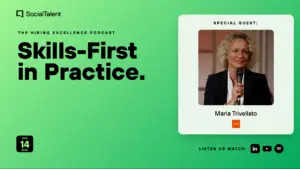
Skills-First in Practice with Wesley Connor & Maria Trivellato
Wesley Connor and Maria Trivellato share how Mastercard and Criteo are moving beyond skills-first announcements to real organizational change. Learn why the biggest barrier isn't technology—it's mindset.
 Johnny CampbellHost · Co-founder & CEO, SocialTalent
What you'll learn
Avoid recruiting a clone of your existing team for every role
Capture hidden skills employees gain through internal moves and gig work
Frame skills initiatives around business outcomes instead of skills jargon
Measure skills programs by gauging employee trust as well as time to fill
00:00
--:--
Episode notes
Episode key takeaways
The HBR research showing most skills-first initiatives fail isn't wrong; it's incomplete. Organizations with genuine business problems—emerging skill gaps, rapid role evolution, internal talent that's invisible—have real reasons to invest. Those without acute skill scarcity or role change are right to skip it.
Ninety-seven percent adoption of Mastercard's internal talent marketplace didn't happen by accident. It required a mature gig culture, clear role definitions, and transparent skill mapping. Getting there demands months of change management, stakeholder translation, and employee feedback loops before any system launch.
Hiring managers default to cloning. Maria's team now uses objective panels to pre-qualify candidates against defined skills rather than letting individual hiring managers select. This structural intervention—not just training—breaks the bias toward hiring people like us and surfaces skill diversity.
Learning and talent acquisition must merge operationally. When hiring and L&D collaborate on the same talent marketplace and skill taxonomy, employees see a bridge: if you didn't get the role, here's the training gap and the timeline to close it. This transforms learning from optional self-service into a strategic mobility tool.
Good to know
Frequently asked questions
The quick answers behind this episode.
Why do most skills-first initiatives fail? +
Many organizations announce skills-first without solving a real business problem. If your market is stable, roles aren’t changing, and you have no trouble hiring, skills-first adds complexity for no return. Success requires acute skill gaps, rapid role evolution, or internal talent you can’t see. It’s a solution to a specific problem, not a universal best practice.
How do you get hiring managers to stop hiring clones? +
Structural intervention works better than training alone. Mastercard uses objective hiring panels that pre-qualify candidates against defined skills, removing individual hiring manager selection bias. This ensures diverse talent reaches the team and breaks the default pattern of hiring people like us. Combine it with feedback showing the business benefits of skill diversity.
What should we measure first in a skills-first rollout? +
Start with adoption and belief. Survey employees and leaders on whether they trust the skills taxonomy you’ve defined—the system collapses if stakeholders don’t believe it’s accurate. Once adoption is solid, move to operational metrics: time to fill, internal mobility rate, and time to market for new products. Business metrics come later.
How do you capture skills employees learn informally? +
Create a talent marketplace where employees and managers can log skills gained through projects, gigs, or cross-functional work. Maria’s organization discovered that people were acquiring new skills through internal mobility and project work but had no way to record them. A transparent system lets employees self-report and managers validate, surfacing hidden capability for internal hiring and development.
Should soft skills be part of the skills taxonomy? +
If you already have a mature behavioral or values framework embedded in feedback, performance management, and hiring, keep it separate. Wesley’s team at Mastercard focused the new taxonomy on hard and technical skills, letting the existing Mastercard Way behaviors handle the how. This reduces measurement complexity and avoids duplication.