Unifying regional teams around a single global process, not a headquarters mandate, was the cultural shift that unlocked scale. Otto's approach was to identify best practices wherever they emerged—Puerto Rico, India, France, the US—and codify them as international standards, then reinforce them through cross-regional 30-minute peer exchanges that built genuine bonds and shared ownership.
The Hiring Excellence Podcast · Episode 207
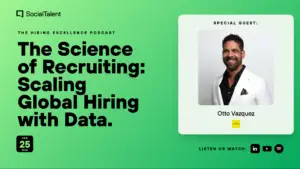
The Science of Recruiting: Scaling Global Hiring with Data
Otto Vasquez, global head of talent acquisition at Sartorius, shares how a scientific approach to recruiting—powered by internal AI tools and structural redesign—cut agency spend by 90% while reducing headcount through internal mobility, not layoffs.
 Johnny CampbellHost · Co-founder & CEO, SocialTalent
What you'll learn
Cut agency spend by building an in-house talent sourcing team
Record a personal welcome video instead of generic scripted interview questions
Build a reusable candidate pool from one-way video interview recordings
Use hard data to win credibility for a global process change
00:00
--:--
Episode notes
Episode key takeaways
Agency spend dropped from over €3 million to €333,000 by building an internal sourcing structure: coordinators handling administration, talent acquisition professionals managing operations, and a dedicated sourcing team responsible for fishing (job posting), hunting (active outreach), and farming (candidate relationship management). The shift from buying headhunter services to owning the capability proved both cheaper and more strategic.
Data became the credibility engine for change. When proposing new processes or tools, speaking the language of the business—numbers, not ideals—removed resistance from scientists and engineers. A market analysis that once took months now takes two hours with AI, with a margin of error of only 2–3%, making the case for automation irrefutable.
Moving from recruiter to talent acquisition professional to business partner required deliberate skill elevation. Teams learned market mapping, competitive analysis, and AI-assisted dashboarding. This evolution meant they could advise on workforce strategy, not just fill requisitions—a shift that justified keeping the function lean even as hiring remained high.
Reducing headcount from 60+ to around 40 without layoffs relied on internal mobility and reskilling. Colleagues moved into HR business partnering, talent leadership development, and organizational development. Those who left TA understood its pain points, so they became better partners in their new roles, strengthening collaboration across the entire HR function.
Good to know
Frequently asked questions
The quick answers behind this episode.
How do you reduce agency spend without losing hiring capacity? +
Build an internal sourcing team with clear role separation: coordinators for administration, TA professionals for operations, and dedicated sourcers for market hunting and candidate farming. This structure replaces expensive headhunter services while maintaining speed and market knowledge. One company reduced agency costs by 90% using this model while scaling globally.
What's the difference between recruiting and talent acquisition? +
Recruiting is the operational, transactional part—moving candidates through a process. Talent acquisition is strategic: market mapping, competitive analysis, workforce planning, and business partnership. The shift from one to the other requires training teams to understand market trends, skill gaps, and long-term demand, not just filling open roles.
How can you use AI without a huge software budget? +
Start with tools you already have—video interview platforms, spreadsheets, dashboards—and layer AI on top to automate repetitive tasks. Use AI to rewrite job descriptions in bulk, analyze candidate profiles for internal mobility, or create market dashboards. The goal is freeing time from admin work, not buying expensive platforms. Most insights come from how you frame the data, not the tool itself.
How do you get buy-in for global TA process changes in risk-averse organizations? +
Lead with data, not ideology. Identify the language your stakeholders speak—numbers for engineers and scientists—and show the before-and-after metrics. Prove the idea works with a small pilot, then scale. Build relationships across regions through peer exchange and shared ownership so change feels collaborative, not imposed from headquarters.
What's the fastest way to shift a team from transactional to strategic? +
Automate the transactional work first—one-way video interviews, scheduling, initial screening—so the team has time to learn strategy. Then train them on market mapping, competitive analysis, and how to advise hiring managers on workforce trends. The shift takes 2–3 years but compounds as the team gains credibility and stakeholder trust.