The traditional end-to-end recruiter is fragmenting into three distinct specializations: candidate concierges who own relationship and closing, AI system managers who handle sourcing and technical optimization, and strategic business partners who drive metrics and market insights. This shift isn't just efficiency—it's about playing to individual strengths rather than forcing generalists to excel at everything.
The Hiring Excellence Podcast · Episode 216
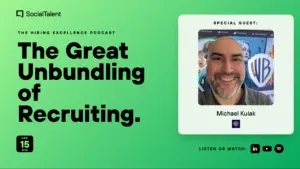
The Great Unbundling: How AI Is Fragmenting the Recruiter Role
The full-stack recruiter is becoming obsolete. Michael Kulak, Global Director of TA at Warner Bros. Discovery Games, breaks down how AI is splintering recruiting into specialized roles—and why losing junior talent in the process could backfire.
 Johnny CampbellHost · Co-founder & CEO, SocialTalent
What you'll learn
Split full-stack recruiting into specialized roles like candidate concierge
Keep human closers for top candidates instead of an all-AI face
Preserve junior recruiter pathways so senior talent doesn't disappear later
Adopt skills-first hiring to bring relationship or data talent inward
00:00
--:--
Episode notes
Episode key takeaways
Top-of-funnel automation and scheduling logistics are genuinely ready for AI today, but quality of hire remains stubbornly human. The metric that matters most—time to impact—depends on trust, clarity, and negotiation skills that no chatbot can replicate, especially when recruiting passive candidates who won't engage with automated outreach.
Michael Kulak warns that automating away junior recruiter roles risks creating a talent desert five years from now. If coordinators and sourcers disappear into AI, there's no pipeline to develop the relationship managers and technical specialists the industry will desperately need when the pendulum swings back.
Even within a single stage like offer-making, there's a hybrid model: humans own the negotiation and relationship, while AI handles contract generation, compliance checks, and approval workflows. Treating entire stages as either all-human or all-machine misses the nuance where real efficiency lives.
Skills-first hiring offers a path forward—bringing in salespeople, data analysts, and operational experts and applying their core competencies to recruiting. But without fundamental recruiting knowledge, these specialists will design processes that work on paper but fail for hiring managers and candidates.
Good to know
Frequently asked questions
The quick answers behind this episode.
What parts of recruiting are AI actually ready to automate today? +
Top-of-funnel screening (narrowing 5,000 applicants to 100–200 viable candidates), scheduling and logistics, and administrative tasks like contract generation and compliance checks. These reduce time-to-hire without sacrificing quality. However, candidate relationship-building, negotiation, and closing remain human-driven for competitive talent.
How should recruiting teams restructure as AI takes over sourcing? +
Three emerging roles: candidate concierges (relationship and closing), AI system managers (technical sourcing and prompt optimization), and strategic business partners (metrics, branding, market insight). Each plays to different strengths rather than forcing one person to excel at everything.
Why is automating junior recruiter roles dangerous? +
Eliminating coordinator and sourcer positions removes the pipeline for developing future relationship managers and technical specialists. When businesses realize they need human touch again—which history suggests they will—there won’t be trained talent available to fill those gaps.
Can you hire salespeople or data experts into recruiting roles? +
Yes, but with a caveat: they need fundamental recruiting knowledge alongside their core skill. Hiring managers and operations experts without recruiting experience often design systems that are efficient on paper but fail in practice because they miss recruiting’s unique nuances.
How do you keep top candidates engaged if they only see AI? +
You don’t. Passive candidates and high-end talent won’t respond to automated calls or chatbots. The concierge model starts with a human touch—’I am not AI. I’d love to talk to you’—then uses automation for logistics, not relationship-building.