
By David Deady
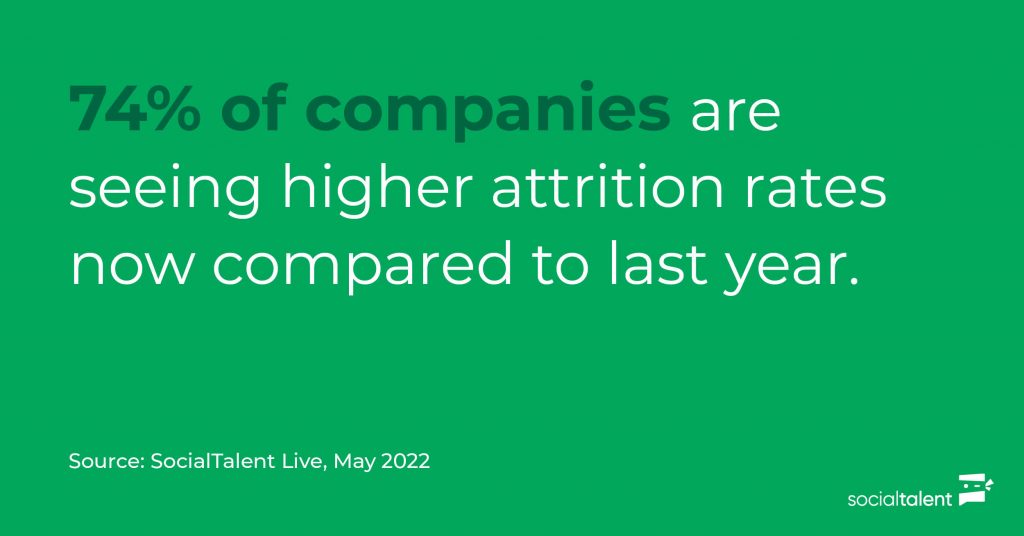
 We all remember how The Great Resignation signalled a massive shift. Many tried to ignore or deny it, but according to our research, 74% of companies are still seeing higher attrition rates still to this day. Employees are leaving in their droves, and these leaky buckets are having huge impacts on organizations. From the added strain of being down on manpower, to the difficulties in finding talent in this market – it all only compounds the situation more. Employers need to up their game or else retention will become a systemic problem.
Why are employees leaving at the moment?
While not an exhaustive list, the below gives some insight into the common reasons why employees are deciding to leave companies.- Desire for more flexibility
- Change of priorities following COVID
- Salary
- Opportunities for career growth
- Lack of recognition
- Remote or hybrid working
- Feeling overworked or burnout
- Dissatisfaction with management
1. Build a culture of learning and development
A focus on learning and development has become an essential ask from employees. No one wants to stagnate in their role. In fact, according to a recent poll SocialTalent conducted, career growth opportunity was selected as the primary motivator for employee engagement. Giving your team the time, space, and encouragement to upskill will not only pay dividends in terms of personal development, it also keeps an organization agile. New ideas and a willingness to try different things are essential for getting innovation to the forefront. It’s a win-win. According to Jenna Dobbins, the Global Head of HR at Pontoon:Jenna also pointed out that building this culture requires commitment on both sides. Everyone has a role to play when it comes to promoting and building awareness of learning and development.“Growing and development is a key part our expectation. We encourage everyone to engage with L&D and there are annual targets that we’re all working towards. It gives the global organization a sense of unity.”
Discover how Pontoon created their culture of learning and development in this recent case study.
2. Set the tone during the onboarding experience
It’s a shocking statistic, but according to a HiBob survey, as much as 64% of employees are likely to leave an organization within the first year after having a poor onboarding experience. This is a major retention red flag. First impressions are everything. And if you aren’t putting your best foot forward to begin with, employees will not be encouraged to stick around. An effective, clear and engaging onboarding experience is essential. But it’s so often overlooked in an organization’s list of priorities. During SocialTalent Live, Dan Heath, the New York Times bestselling author of The Power of Moments, said that the first day “is the single most important day of establishing your perception of an employer.” He advocated for companies to avoid the bureaucratic, box-ticking monotony that has become a norm, and instead create a moment. Try to ensure that when a new employee finishes their first day they feel like they matter. That the work matters.John Deere create near-perfect first days. Listen to Dan talk about their onboarding experience during his appearance on The Shortlist.
3. Drive retention through internal mobility
According to HBR, only 28% of talent acquisition leaders today report that internal candidates are an important source of people to fill vacancies. Yet we know that career progression and opportunity to grow are of vital importance for employee retention. This sentiment was echoed in a recent Korn Ferry report, where ‘achieving career goals at a company’ was cited as an early predictor of retention for employees. And with top talent in such short supply right now, increased adoption of internal mobility could very well kill two birds with one stone when leveraged properly. But why is it so underutilized? Yasar Ahmad, the Global VP of Talent at HelloFresh, explained that there’s a fear factor involved. That when a role is filled by an internal candidate, there is still a role to backfill. He advocates for a shift in thinking on this front, moving away from a pure numbers game and establishing a more macro overview. Glen Goodman, the CHRO of Talent Matters, agreed with this and added that there needs to be more transparency and communication around internal mobility. “A lot of leaders forget their own internal mobility moments,” he said. “Someone did that for them at one point, someone supported them – make it personal.”Our ebook on internal mobility can give you even more advice on how best to leverage this.
4. Use regular pulse surveys to focus your retention efforts
Perhaps this goes without saying, but in order to truly diagnose any systemic problems that could be leading to increased staff attrition, your organization must have oversight. And regular pulse surveys are a fantastic means of doing just that. For Jenna in Pontoon, they highlighted a lack of awareness over L&D opportunities for example, allowing the company to address and rectify the issue. But this is where you need to be careful. Simply creating surveys won’t fix any problems. Targeted action needs to follow. Tomya Watt, the VP of Talent and Mobility at MSK, refers to this as the “show and tell approach.” You have to show that you’ve heard and tell your employees what you’re going to do with the feedback.To learn even more tactics for helping to improve employee retention, what not watch the full recording of SocialTalent Live: Engaging and Retaining Talent in 2022?
SocialTalent also has a vast library of content tailor made to enable organizations to retain the best talent. Get in-touch with us today to find out more.
Frequently Asked Questions
Why is employee retention still such a major challenge for companies?
Employee retention remains a major challenge because, per SocialTalent’s own research, 74% of companies are still seeing higher attrition rates in the aftermath of the Great Resignation. Common reasons employees leave include desire for more flexibility, stagnant salaries, lack of career growth, burnout, and dissatisfaction with management.
How does a poor onboarding experience affect employee retention?
A poor onboarding experience significantly increases early attrition: a HiBob survey found that 64% of employees are likely to leave a company within their first year after a bad onboarding process. Making an employee’s first day feel meaningful, rather than a bureaucratic checklist, is described as critical to shaping their lasting perception of the employer.
Does internal mobility actually improve employee retention?
Yes, internal mobility is linked to stronger retention: a Korn Ferry report found that achieving career goals at a company is an early predictor of whether employees stay, yet only 28% of talent acquisition leaders see internal candidates as an important hiring source, according to HBR. Increasing internal mobility can address retention and hiring needs at once.
What is the “show and tell” approach to employee pulse surveys?
The ‘show and tell approach,’ a term used by MSK’s VP of Talent and Mobility Tomya Watt, means visibly acting on employee feedback rather than just collecting it through pulse surveys. Surveys can reveal specific gaps, such as low awareness of learning and development opportunities, but only targeted follow-up action actually improves retention.