
By Johnny Campbell
Hiring org structure shapes how quickly roles move, how consistently candidates are evaluated, and how much influence talent acquisition has with the business.
This article maps five maturity levels, from reactive HR-led hiring to an integrated talent partner model, so you can see where your organization sits and what a stronger structure looks like.
At a glance:
- Most companies start without dedicated recruiters, then build specialized recruitment operations as headcount planning becomes more formal.
- The Level 3 shift to talent advisory is where structured scorecards, recruitment metrics, and business-aligned org charts start to matter.
- At Level 4, agile hiring sprints and pre-built talent pipelines help teams prepare for critical roles before a requisition opens.
- Level 5 expands the talent partner model into internal mobility, learning and development, workforce planning, and org design.
- Use the closing self-audit questions to assess your current structure and identify the gaps holding your TA function back.
If I’ve said this once, I’ve said it a thousand times:
Hiring isn’t just about filling jobs – it’s about building the right structure to make hiring a competitive advantage.
And yet, organizational design is often an afterthought in talent acquisition.
Why Most Hiring Structures Are Built for a Different Era
Too many companies inherit a hiring structure that was built for a different time – one that’s inefficient, reactive, or simply not fit for purpose in today’s world. Some companies still treat recruiting as an HR admin function, while others have moved to a business-integrated talent model.
So, how does talent acquisition org structure evolve as companies mature? What separates a basic recruiting function from a strategic talent acquisition organization?
That’s exactly what we’ll explore in this installment in our series on the Hiring Excellence Maturity Model, breaking down how recruitment team structures evolve across five levels of maturity, and what the best companies are doing differently.
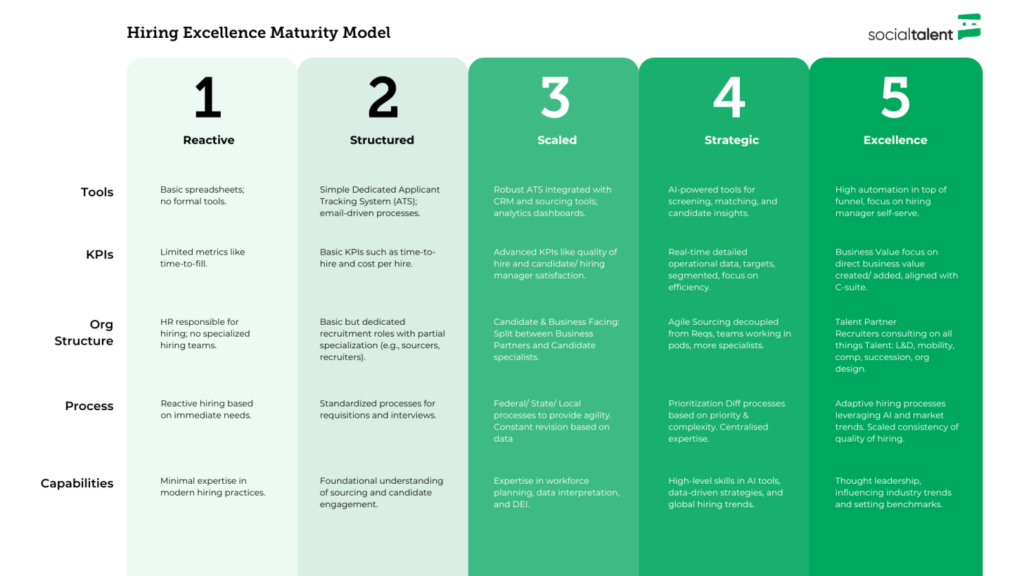
Level 1: Reactive Hiring (HR Handles It, When They Have Time!)
Hiring is nobody’s job until it’s everybody’s job. And that’s where chaos begins to breed.
At Level 1, recruitment isn’t a dedicated function – it’s just one of many tasks on an overstretched HR team’s to-do list. Or, in start-ups and smaller companies, the owner or a senior manager might even be doing the hiring themselves, fitting it in between their other responsibilities.
Recruitment is so fragmented at this level and elements and symptoms of these inefficiencies can bleed into larger companies as well – I’ve seen it!
What this looks like:
- No dedicated recruiters: HR generalists handle hiring alongside payroll, compliance, and performance management. It is not a priority.
- Hiring is inconsistent: Different people manage it in different ways, often reinventing the wheel with every open role.
- High reliance on agencies: Because nobody internally has the time or expertise to source talent effectively.
There is no proactive hiring at this stage, no consistent standards, and it can be an expensive and inefficient approach.
Level 2: Dedicated Recruiters (But Hiring Is Still Just a Function)
At some point, recruiting can’t be an afterthought anymore. Companies reach a stage where they need to bring hiring in-house, shoring up the standards and processes, even to a basic level. And this is where Level 2 begins.
What this looks like:
- Dedicated recruiters are hired, but TA is still a transactional function, not a strategic partner.
- Some specialization emerges: maybe a sourcer, an employer branding lead, or an early career recruiter. But it’s basic segmentation at this point.
- Recruiters take job orders rather than shaping hiring strategy.
For smaller companies, you might be looking at one or two dedicated recruiters who handle all hiring but lack specialization. At a mid-size, perhaps a small TA team exists, but HR may still oversee hiring policies and processes.
While for larger enterprises, recruiting at Level 2 is structured, but still highly transactional, in that when a job opens, the recruiter fills it, rinse, repeat.
Why this hold companies back:
- Hiring remains reactionary: Recruiters step in when roles open but don’t pipeline for future needs.
- There’s little alignment with the business: Hiring managers still dictate the process, and recruiters aren’t true partners.
- Process inconsistencies: While an applicant tracking system (ATS) may be in place, teams often lack structured interview frameworks, scorecards, and consistent evaluation criteria, meaning business units still hire in different ways.
The takeaway at this level is quite straightforward: While hiring becomes more structured, it’s still tactical rather than strategic.
Level 3: Scaled Recruiting (The Shift to Talent Advisory)
At Level 3, the real shift happens. TA teams move beyond filling requisitions and start shaping hiring strategy. This is exactly the point where we see recruiters move away from HR, separate into a dedicated arm, and evolve into Talent Advisors who begin to partner with the business, understanding the core needs while also bringing expertise and strategy to the table.
What this looks like:
Hiring teams are generally split into two core areas at Level 3:
- Business-facing recruiters: Act as trusted advisors to hiring managers, aligning talent acquisition planning to wider business incentives.
- Candidate-facing specialists: Sourcers and talent marketers who proactively build pipelines.
Why this matters:
- Hiring managers want a single point of contact – not a different recruiter for every skill set.
- TA teams become proactive, with talent pipelines in place for critical hiring areas.
- As we discussed in an article on Tools, a recruitment CRM is introduced here, allowing teams to track talent beyond just active applicants.
LinkedIn’s Future of Recruiting 2025 report also points to this shift, with recruiters moving toward more strategic work such as advising hiring managers and building stronger candidate relationships.
Essentially, hiring is no longer just a function. You move away from the recruiter-per-job model and instead, hiring becomes a considered, business-aligned strategy.
And this transition can exist from small start-ups to large enterprises – it’s about adopting a forward-thinking, process-driven, business-focused approach to hiring.
Level 4: Agile & Strategic Hiring (Just-in-Time Talent Pipelines)
Here’s where companies stop reacting to open jobs and start anticipating hiring needs. At Level 4, recruitment operations shift from reactive requisition-filling to proactive pipeline building for critical roles.
That’s where operational excellence in recruiting matters: it gives teams the process discipline to manage pipelines, prioritization, and recruiter capacity without slipping back into reactive hiring.
What this looks like:
- Hiring teams may run on agile sprints, not job requisitions.
- Some Recruiters are measured on activated candidates, not just hires.
- Sourcing is decoupled from requisitions for core roles – meaning talent pools are built before roles even open.
- Pipelining is prioritized for roles that are always in demand within the organization.
Think about what this might look like. Instead of waiting for a hiring manager to say, “I need a new designer,” the TA team already has six pre-qualified candidates lined up – they’ve been nurturing relationships, gathering insights, and tracking their readiness so when the need arises, they’re not starting from scratch.
Why this matters:
- Time-to-hire drops massively because recruiting never truly stops.
- The TA team acts like a marketing and sales function, proactively engaging talent before they’re needed.
- Not every req is equal: Organizations begin prioritizing hires differently.
With a shift to continuous sourcing, prioritization, and agile hiring sprints, Level 4 organizations unlock a critical advantage: they’re no longer scrambling to find talent when a role opens – they already know who’s next.
Level 5: The Talent Partner Model (Hiring Is Just One Part of the Bigger Picture)
At Level 5, TA is no longer just about recruiting. It’s part of a broader workforce strategy. The Talent Advisor role expands beyond recruitment to include other areas of the employee lifecycle including mobility, learning & development, and workforce planning.
What this looks like:
- The Talent Business Partner role expands beyond hiring covering internal mobility, workforce planning, and even org design.
- TA integrates with HR and L&D, creating a holistic approach to developing and retaining talent.
- Budgets are allocated flexibly across talent priorities – hiring, upskilling, retention, and succession planning.
At Level 5, a hiring manager will work with a talent partner to assess all options when it comes to talent. Can we upskill existing employees? Does there need to be an adjustment in the org structure itself? Are we hiring for the capabilities?
This is the current goal of hiring excellence when it comes to organizational structure. Here, you’re thinking beyond job requisitions and designing and managing a workforce proactively.
Where Does Your Organization Sit Today?
Just like the other elements within the maturity model, most companies won’t fit neatly into one level – they straddle multiple stages and processes across different parts of the business.
So ask yourself:
- Is our talent acquisition team structure designed to meet both high-volume and specialized hiring needs effectively?
- Do we have clear lines of accountability between recruiters, hiring managers, and HR Business Partners?
- Does our TA function have a seat at the strategic planning table, or is it largely an execution-focused department?
- Does our current structure help or hinder our ability to deliver a consistent, high-quality candidate experience globally?
- If candidate experience is one of your measures, candidate experience metrics can show where delays, drop-off, and feedback gaps are hurting the journey.
- Are we tracking recruiting KPIs like time between stages, feedback lag, and source effectiveness to identify bottlenecks?
What a Stronger Hiring Structure Actually Unlocks
A company’s hiring structure tells you everything about how seriously it takes talent. If recruitment is buried under HR admin, hiring will always be an afterthought.
But as organizations move up the Hiring Excellence Maturity Model, they unlock a more strategic, scalable, and impactful way to attract and retain talent.
The best companies don’t just react to hiring needs; they design a structure that turns talent into a competitive advantage.
Next Up: How Hiring Processes Must Evolve
Organizational structure is just one piece of the puzzle. Next, we’ll explore how Hiring Processes evolve across these five levels – because even the best team structure won’t work if the process is broken!
See you next week, folks!
