Replacing CV screening with immersive, situational assessments unlocked a 50% reduction in time-to-hire at H&M, while simultaneously widening the talent pool. Candidates from hospitality and adjacent industries emerged as top performers—a pattern invisible under resume-first filtering. The shift wasn't about cutting recruiters; it was about reclaiming store manager time for team leadership and customer service.
The Hiring Excellence Podcast · Episode 174
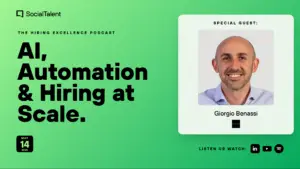
AI, Automation & Hiring at Scale with Sephora’s Giorgio Benassi
Giorgio Benassi shares how immersive assessments and AI agents replaced CVs in high-volume retail hiring, cutting time-to-hire by 50% and reducing attrition by 20%+. Learn what actually works—and what doesn't—when automating store hiring.
 Johnny CampbellHost · Co-founder & CEO, SocialTalent
What you'll learn
Replace CV screening with immersive assessments that reveal real personality fit
Expect automated screening to cut attrition alongside faster time to hire
Vet AI vendors on their assessment framework, not flashy interface features
Keep human judgment as the final decision point in AI-driven hiring
00:00
--:--
Episode notes
Episode key takeaways
Attrition dropped more than 20% after assessment-driven hiring rolled out across 80% of H&M stores globally. Better hiring quality compounds: experienced staff drive higher sales, lower onboarding costs, and reduced replacement cycles. Giorgio emphasizes this is a lagging indicator that validates the entire model.
Assessment design is the unglamorous foundation that separates credible AI tools from expensive noise. Many vendors pitch AI agents without explaining what competencies they actually measure or how. Giorgio's core lesson: demand a transparent, evidence-based framework for what the tool assesses—not just a slick UI and promises that 'the algorithm figures it out.'
The future role of recruiters shifts from gatekeeper to relationship steward. Rather than deciding who passes, recruiters will explain company culture, keep candidates engaged through assessments, and ensure human connection persists even as AI handles capability evaluation. This reframe opens automation to corporate hiring, not just retail.
Guaranteeing every applicant an interview—not a CV review—becomes technically possible with AI. Giorgio frames this as replacing a paper submission with a tailored conversation, improving candidate experience while surfacing richer signal. Human judgment remains at the final decision gate, but the path to that gate is now automated and fairer.
Good to know
Frequently asked questions
The quick answers behind this episode.
How much did time-to-hire improve after switching to AI-driven assessments? +
Time-to-hire dropped almost by half at H&M after rolling out immersive, situational assessments in place of CV screening. The pilot began in half the Netherlands stores and a few US locations, with results visible immediately. The solution scaled to roughly 80% of H&M stores globally before Giorgio left the company.
What's the difference between an AI assessment tool and an AI recruiting agent? +
An assessment tool measures specific competencies—personality, service mindset, problem-solving—using a structured, evidence-based framework. An AI agent automates workflow: scheduling, follow-up, candidate communication. Giorgio stresses that agents are only as good as the assessment capabilities they’re built on. Without robust assessment design, agents produce noise, not signal.
Can AI hiring work for corporate or professional roles, or just retail? +
Giorgio sees gradual expansion into corporate hiring, though less automation of the full process. He’d automate capability assessment more than volume hiring, then layer human judgment on top. The recruiter role evolves from gatekeeper to relationship manager—explaining company culture and keeping candidates engaged while AI handles evaluation. This hybrid model applies across segments.
Why does attrition matter more than time-to-hire in retail hiring ROI? +
Attrition directly reduces hiring volume. Better-matched hires stay longer, so you recruit fewer replacements. Experienced staff also drive higher sales and lower onboarding costs. Giorgio notes attrition fell 20%+ after assessment-driven hiring, compounding savings across recruitment, training, and revenue per employee.
How do you keep human judgment in an AI-automated hiring process? +
Giorgio’s model: AI conducts the interview or assessment, then a human reviews all data and makes the hire/no-hire decision. Another AI tool may handle scheduling. The final decision gate remains human. This preserves accountability and allows for context or exceptions that algorithms miss, while still capturing efficiency gains from automation.