Start with a concrete business problem, not the technology. The two strongest cases are: hiring fewer people overall (direct cost savings) or hiring the same volume with fewer recruiters. Without a meaty, quantifiable problem—turnover costs, hiring manager opportunity cost, speed-to-fill blocking revenue—the initiative stalls at pilot stage.
The Hiring Excellence Podcast · Episode 185
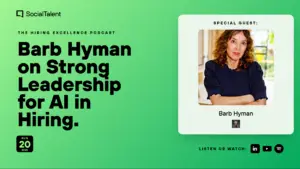
Barb Hyman on Strong Leadership for AI in Hiring
Deploying AI in hiring requires more than technology—it demands strategic leadership, a compelling business case, and organizational buy-in. Barb Hyman shares how to navigate compliance, change management, and stakeholder resistance.
 Johnny CampbellHost · Co-founder & CEO, SocialTalent
What you'll learn
Build a hiring business case around fewer hires or fewer recruiters
Defend AI hiring decisions with bias testing and explainability evidence
Win hearts and minds internally through storytelling before a rollout
Fund an AI pilot internally instead of requesting new budget
00:00
--:--
Episode notes
Episode key takeaways
Storytelling and data literacy separate leaders who succeed from those who don't. Winning hearts and minds requires a clear North Star, transparent reasoning for the change, and the ability to track 2–3 lead indicators that predict retention. Most HR leaders can't articulate their core metrics despite having Workday or SuccessFactors.
Regulation creates clarity, not friction. GDPR and EU AI frameworks have built compliance muscles that make implementation faster in Europe than the US. Leaders in regulated markets face fewer unknowns; those in embryonic regulatory environments must build governance frameworks on the run with their vendors.
Fund the pilot yourself rather than asking for net-new budget. Redirecting existing spend—ad budgets, tool consolidation—signals leadership conviction and removes the 'shiny new toy' perception. The client's anxiety peaks after signing; your job is enterprise empathy and celebrating when they celebrate, not when the deal closes.
Technology is 10%; people and change management are 90%. Even with a production-ready product, implementation timelines stretch across organizational layers—legal, compliance, InfoSec, store managers who'll never meet the vendor. Pace matters. Start small (assessment), prove value, then expand into CRM, reference checks, or talent management.
Good to know
Frequently asked questions
The quick answers behind this episode.
How do you build a business case for AI hiring technology? +
Quantify either cost reduction (fewer hires needed) or efficiency gains (same hiring volume, fewer recruiters). Track hiring manager time via calendar data—multiply hours saved by salary to show opportunity cost. Measure retention as the lag indicator; it signals hiring quality, culture, and leadership effectiveness. Avoid soft metrics like ‘time savings’ unless tied to revenue impact.
What role does regulation play in AI hiring implementation? +
Regulation provides boundaries and clarity that accelerate decision-making. GDPR and EU AI frameworks have built compliance muscles in European organizations; US leaders face more ambiguity with state-based rules and embryonic federal guidance. Regulated markets move faster because stakeholders understand the guardrails. Governance frameworks must address bias testing, explainability, transparency, and data sovereignty.
How do you overcome legal and compliance resistance to AI in hiring? +
Secure top-down C-suite and board openness to AI first. Then work with legal and compliance as partners, not gatekeepers. Show them how your vendor tests for bias, provides reasoning for every decision, and maintains data privacy. Transparency builds trust. Treat AI to a higher defensibility standard than human judgment—this resonates with risk-averse stakeholders.
What's the difference between AI for automation versus AI for intelligence? +
Automation replicates existing processes faster; intelligence improves decision-making. True AI hiring captures deep data about candidate skills and context through structured conversation, then uses that data across hiring, onboarding, development, and feedback. If a vendor’s pitch is ‘automate what you’re doing,’ they’re not the right fit. The power is in the data and reasoning, not the speed.
How should leaders communicate AI hiring changes to their teams? +
Use storytelling tied to business strategy, not technology. Explain the North Star, why it matters, and what investment is needed. Acknowledge that roles will change—some recruiters may feel threatened. Go at the organization’s pace; one recruiter took stress leave after learning their job would be redesigned. Celebrate milestones with the client, not just at contract signature.