The classic talent silos—learning and development, talent management, and talent acquisition—operate in isolation despite serving the same employee population. L&D focuses on structured learning; talent management owns succession and high-potential identification; TA typically looks outward. Breaking these silos requires a unified skill ontology and deliberate cross-functional collaboration, not just better software.
The Hiring Excellence Podcast · Episode 123
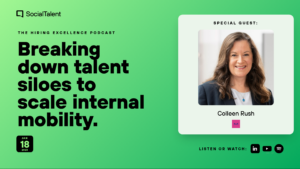
Breaking down talent siloes to scale internal mobility | with Colleen Rush
Internal mobility consistently ranks as a top workplace indicator, yet most organizations struggle to connect employees with opportunities. Colleen Rush shares how to dissolve silos between TA, L&D, and talent management to unlock career progression at scale.
 Johnny CampbellHost · Co-founder & CEO, SocialTalent
What you'll learn
Recognize why employees rarely act on internal mobility despite wanting it
Push for one shared skill ontology across learning, talent and hiring systems
Spot bonus structures that quietly punish managers for releasing top talent
Pair every training investment with real world practice to make skills stick
00:00
--:--
Episode notes
Episode key takeaways
Marketplace platforms alone don't drive internal mobility. Most employees don't actively browse job postings, so passive discovery fails at scale. The real solution emerges when AI begins proactively surfacing gigs, short-term assignments, and role matches to internal candidates—a capability still in early stages across vendors.
Manager incentives often work against mobility. When bonuses reward team retention, talent hoarding becomes rational behavior. Shifting KPIs to measure talent development and distribution, combined with tone-from-the-top support, signals that moving high performers is a leadership strength, not a loss.
Real-world practice bridges the gap between training and readiness. A course certificate alone doesn't convince hiring managers; they want evidence of applied skill. Pairing formal learning with stretch assignments—simultaneous or shortly after—creates the conditions where people actually develop capability and build visibility across teams.
Forty percent of 58 displaced employees found internal roles across three distinct business units through deliberate TA intervention: resume books, preferential consideration, and skill-translation coaching. The playbook works: combine technology, process rigor, cultural messaging, and people-powered advocacy to move the needle on internal placement.
Good to know
Frequently asked questions
The quick answers behind this episode.
What is internal mobility and why does it matter for retention? +
Internal mobility is the degree to which a company supports employees to pursue career interests through job changes inside the organization. It matters because employees approached by external recruiters with attractive roles they haven’t found internally often leave. Making it easier for people to realize career aspirations internally directly combats this talent leakage and improves retention.
What are the main obstacles to internal mobility in large organizations? +
Employees face overwhelming choice (4,500+ openings at once), inconsistent job titling, unclear skill transferability, and low awareness of opportunities. Companies struggle with lack of transparency on internal talent—often relying on LinkedIn instead of internal systems. The biggest blocker: employees don’t populate talent management profiles, so skills data remains invisible to hiring managers.
How do you create a unified skill language across TA, L&D, and talent management? +
Vendors currently fragment along silos, each using different skill ontologies. The solution is to buy a standardized skill ontology and enforce consistent use across platforms—talent acquisition, learning and development, and talent management. Without this foundation, AI-driven matching and career coaching remain unreliable.
What role should stretch assignments play in internal mobility? +
Stretch assignments—projects or gigs where employees lack 100% capability—create the real-world practice that courses alone cannot provide. Pairing formal training with simultaneous or near-term stretch work builds applied skill and visibility across departments. This combination also solves the networking gap: employees meet new teams and leaders while developing competency.
How can TA support internal mobility beyond job posting platforms? +
TA can co-host internal career fairs, offer resume clinics and interview coaching, and provide preferential consideration to internal applicants—treating them like external candidates deserve. Pairing TA advisors with displaced or transitioning employees to translate skills across business units and coach on career gaps accelerates internal placement and demonstrates organizational commitment to mobility.