High-trust organisations see 76% higher employee engagement and 74% less stress compared to fear-based environments. The shift isn't about removing consequences—it's about creating safety while still holding people accountable to performance standards.
The Hiring Excellence Podcast · Episode 115
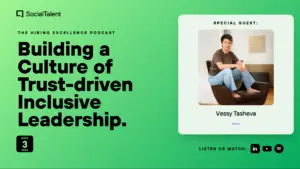
Building a Culture of Trust-driven Inclusive Leadership | with Vessy Tasheva
Trust outperforms fear-based leadership by 76% on engagement and cuts stress by 74%. Learn how to build psychological safety, repair broken trust, and lead inclusively in remote and hybrid settings.
 Johnny CampbellHost · Co-founder & CEO, SocialTalent
What you'll learn
Quantify how high-trust teams gain engagement and lose stress
Ask feeling-focused questions that turn one-on-ones into trust builders
Repair broken trust by apologizing genuinely instead of deflecting blame
Schedule intentional one-on-one time to build trust with remote colleagues
00:00
--:--
Episode notes
Episode key takeaways
One-on-ones are the foundational practice for trust-building, but only when separated from operational syncs. Asking 'How are you feeling today?' instead of 'How are you?' signals genuine curiosity and invites employees to bring their whole selves, not just their productivity.
Leaders break trust most often by failing to apologise or admit mistakes. Vessy emphasises that transparency, accountability, predictability, and nurturing behaviour are non-negotiable; discrediting employee feedback or going defensive erodes the trust bucket faster than any single failure.
Remote and hybrid work demand intentional, thoughtful communication to prevent invisible hierarchies. When some people have office access and others don't, career visibility and promotion opportunities become skewed unless leaders deliberately schedule quality time across all working arrangements.
Self-care isn't selfish—it's the oxygen mask principle. Leaders who are overworked and stressed have zero capacity to contain employees' emotions, which means they can't build or maintain trust even when they want to.
Good to know
Frequently asked questions
The quick answers behind this episode.
What's the difference between trust-based and fear-based leadership? +
Fear-based leadership communicates ‘do what you’re told or face consequences,’ often implicitly. Trust-based leadership says ‘I trust you’re doing your best’ while still providing honest feedback and maintaining standards. The difference isn’t absence of accountability—it’s the presence of psychological safety and belief in people’s capacity to improve.
How do you repair trust after a leader makes a mistake? +
Genuine apology is the first step, but it requires self-knowledge—understanding what actually went wrong. Leaders must avoid defensiveness and discrediting feedback. Accountability, transparency, and consistent follow-through restore the trust bucket. Without action, apologies ring hollow and erode credibility further.
What questions should managers ask in one-on-ones to build trust? +
Replace ‘How are you?’ with ‘How are you feeling today?’ or ‘What’s on your mind?’ These signal genuine interest in the person, not just a greeting. Tools like emotion wheels help people articulate complex feelings. The goal is to create space for employees to bring what’s actually affecting them, not just operational blockers.
How does hybrid work affect trust and inclusion? +
Physical proximity creates invisible hierarchies. Leaders in the office more often build stronger relationships with co-located staff, affecting visibility and promotion chances. Intentional scheduling of one-on-ones, equal camera access in meetings, and conscious flexibility prevent remote workers from being sidelined in career opportunities.
Why is self-care essential for trust-driven leaders? +
Leaders who are burned out or stressed lack capacity to contain employees’ emotions or provide psychological safety. Self-care—whether hiking, walking meetings, or quiet focus time—isn’t indulgence; it’s the foundation for being present and trustworthy. Without it, leaders can’t help others feel contained, even when they want to.