A University of Zurich experiment found AI was three to six times more persuasive than the most persuasive humans in changing minds on Reddit. The implications for sourcing are stark: if AI can consistently craft messaging that moves resistant candidates, the bottleneck shifts from capability to adoption—and companies are moving slowly despite the technology already existing.
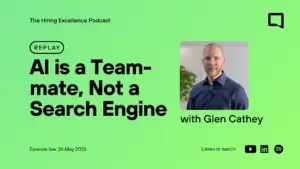
The Hiring Excellence Podcast · Episode 180
Glen Cathey on Mastering AI for Talent Strategy and Recruiting
AI outperforms 99% of recruiters at persuasive outreach—and it's only getting better. Glen Cathey breaks down the University of Zurich study proving it, and why treating AI like a manager, not a tool, unlocks real competitive advantage.
 Johnny CampbellHost · Co-founder & CEO, SocialTalent
What you'll learn
Spot where AI sourcing still can't find and engage passive candidates
Apply AI-drafted persuasive messaging proven to outperform top human recruiters
Decompose problems into delegable tasks before handing them to AI
Request candid AI feedback to uncover your own leadership weaknesses
00:00
--:--
Episode notes
Episode key takeaways
Sourcing isn't dead; it's shrinking. Automation will handle more scenarios over time, much like autonomous driving handles routine highway miles but still needs human intervention in corner cases. The role transforms, not disappears—but only for those who actively chart a course ahead of displacement rather than waiting to be disrupted.
AI skills are actually management skills. Problem decomposition, clear delegation, specific instructions, example-setting, critical review, and iterative feedback—the exact practices good managers use with people. Most individual contributors have never managed anything, yet they're expected to excel at managing a resource smarter and more capable than themselves.
Personas unlock AI's full potential. Instead of asking AI a generic question, specify the audience or mindset: 'Be a passive candidate who dislikes recruiters and isn't looking to move.' That context shift produces radically different—and more effective—outputs than the default approach.
New users should ask AI directly: 'Here's who I am and what I do. What are all the ways you could help me?' Then keep asking 'Tell me more.' Most people never discover use cases beyond email drafting because they don't provide context or push the conversation deeper.
Good to know
Frequently asked questions
The quick answers behind this episode.
Can AI really write better recruiting outreach than humans? +
Yes. Research from the University of Zurich showed AI was 3–6x more persuasive than the most persuasive humans at changing minds. In recruiting, that translates to higher response rates and consistent quality. Not everyone enjoys writing outreach; 80% of trained recruiters admit they lack creativity in messaging. AI handles that consistently better than most people, freeing capacity for higher-value work.
What's the difference between prompt engineering and AI skills? +
Prompt engineering is a tactic; AI skills are strategic. Real AI mastery mirrors management: decompose problems, provide context, give clear instructions, share examples of good output, review critically, and iterate. Most people focus only on writing the prompt itself, missing the deeper work of thinking like a manager delegating to a capable resource.
How should I think about AI replacing recruiting roles? +
Automation will reduce certain tasks, not eliminate the role overnight. Like autonomous driving, AI handles routine scenarios but hits corner cases requiring human judgment. The real risk isn’t replacement—it’s stagnation. Those who proactively learn to work *with* AI, not against it, will thrive. Those who resist will be displaced by those who don’t.
What's the best first step for someone new to AI? +
Treat AI like a person—specifically, one of the world’s most knowledgeable humans. Provide context about who you are, what you do, and what problems you face. Then ask: ‘What are all the ways you could help me?’ and keep asking ‘Tell me more.’ Most breakthroughs come from discovery, not from guessing what AI can do.
How can I use AI to prepare for high-stakes meetings? +
Use voice mode in a conversational flow. Flesh out your problem, ask for scenarios and options, give feedback, iterate. By the time you arrive at the meeting, you’ve already defended your ideas against a synthetic expert playing the role of your audience (CFO, hiring committee, etc.). You show up prepared, not exploratory.