AI handles screening, scheduling, and even skill assessment—but it cannot build trust, challenge assumptions, or connect hiring decisions to business outcomes. The human advantage lies in strategic influence: recruiters who coach hiring managers on rubrics, push back on gut feelings, and tie talent decisions to organizational pain points deliver measurable value that automation cannot replicate.
The Hiring Excellence Podcast · Episode 189
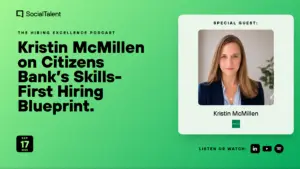
Kristin McMillen on Citizens Bank’s Skills-First Hiring Blueprint
Citizens Bank transformed recruiting from resume-screening to strategic partnership. Kristin McMillen shares how a documented hiring blueprint, three core competencies, and a shift to talent advisory roles are reshaping how 1,500+ managers assess candidates for skills—not just experience.
 Johnny CampbellHost · Co-founder & CEO, SocialTalent
What you'll learn
Coach hiring managers back to the talent profile instead of gut feel
Assess candidates for learning agility over static credentials or tenure
Measure talent-advisor impact with manager surveys tracked over time
Spot individual recruiter skill gaps with a self-assessment rating scale
00:00
--:--
Episode notes
Episode key takeaways
Three core competencies—customer centricity, persistence and tenacity, and learning agility—became the north star for hiring across Citizens. Learning agility emerged as non-negotiable: because skills evolve faster than training programs can keep up, the ability to learn through change is now a must-have, not a nice-to-have.
Kristin's team piloted a 'gray slide' hiring blueprint in January 2024, covering five phases: strategy alignment, recalibration, interview prep, debrief, and offer. By May, 140% of the year's training goal was met, with 98% completion rates in the first cohort—proof that when leadership visibly champions a documented process, adoption accelerates.
Candidate experience NPS in the high seventies signals that skills-based rigor doesn't sacrifice satisfaction. Six months post-launch, hiring managers reported 6% higher confidence in candidate quality and 7% stronger belief in a transparent, evidence-based process—and critically, 4.8/5 stars on understanding why skills-based hiring matters.
The blueprint's reach extends beyond hiring: personalized development plans tied to interview skill gaps, compensation decisions anchored to skill proficiency ratings, and integration into new manager onboarding create a flywheel where hiring becomes the entry point to a skills-first organization.
Good to know
Frequently asked questions
The quick answers behind this episode.
What is a talent advisory role and how does it differ from traditional recruiting? +
Traditional recruiting focuses on filling roles through resume screening, scheduling, and administrative tasks—work increasingly automated by AI. Talent advisory shifts recruiters to strategic partnership: coaching hiring managers on skill rubrics, challenging assumptions, connecting hires to business outcomes, and building trust. It requires thinking strategically, creating empathy, using data to influence decisions, and understanding business context.
How do you measure the success of a skills-based hiring transformation? +
Citizens tracks multiple signals: candidate experience surveys (voice of the candidate) and NPS (high seventies); funnel velocity (time to offer, time to hire); hiring manager sentiment surveys (6–7% upticks in confidence and process transparency); and behavioral anchored rating scales (BARS) for recruiter skill development. Qualitative feedback—managers understanding why skills-based hiring matters—proved equally critical.
What are the three core competencies Citizens uses to hire? +
Customer centricity (keeping customers front and center in service-driven work), persistence and tenacity (resilience in regulated, fast-moving environments), and learning agility (ability to learn and grow through change). Learning agility is the differentiator: it signals whether someone can adapt as skills evolve faster than training can keep pace.
How do you get hiring managers to adopt a new hiring blueprint? +
Citizens leaned into the 50% of managers already bought into better hiring practices, making them champions. Leadership visibly endorsed the process; the CHRO pitched its importance at training kickoff. A two-minute explainer video embedded in new manager onboarding, plus integration into existing leadership development programs, normalized the blueprint as business capability, not compliance training.
What happens after a candidate is hired under a skills-based model? +
Interview debrief skill assessments identify gaps between current proficiency and role requirements. Selected hires receive personalized development and onboarding plans to close those gaps within six months. This creates continuity: hiring becomes the entry point to a skills-first career path, with compensation decisions potentially anchored to skill proficiency ratings captured during interviews.