The industrial model of full-time employment within rigid organizational boundaries is obsolete. Companies like Unilever now think of their workforce as 3 million contributors—not just 150,000 employees—spanning contractors, gig workers, and partners. This reframe unlocks agility and resilience that traditional hiring alone cannot deliver.
The Hiring Excellence Podcast · Episode 109
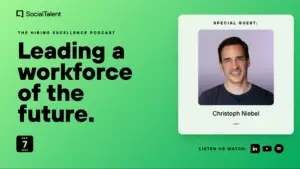
Leading a workforce of the future | with Christoph Niebel
The future of work isn't coming—it's here. Christoph Niebel explores how leaders can shift from managing organizational boundaries to orchestrating an open talent ecosystem, and why learning culture is the competitive edge.
 Johnny CampbellHost · Co-founder & CEO, SocialTalent
What you'll learn
Expand your definition of workforce beyond full-time badged employees
Measure time-to-ramp instead of time-to-fill to reflect business impact
Tie compensation incentives directly to measurable learning hours completed
Build followership through vulnerability rather than positional authority
00:00
--:--
Episode notes
Episode key takeaways
A six-million-job-opening gap versus unemployed workers in the US suggests skill shortages won't reverse during recession. Unless a black-swan event occurs, labour markets will remain tight, making upskilling and reskilling non-negotiable investments rather than nice-to-haves for competitive survival.
Christoph argues that leadership is the linchpin: setting a clear north star, building trust through vulnerability, giving people permission to fail, and anchoring incentives to learning outcomes. Pontoon ties 15% of short-term bonuses to a 52-hour annual learning goal per employee—proving that culture shifts when money follows words.
The industry's language and metrics are misaligned with business reality. Shifting from 'time to fill' to 'time to ramp' or from 'open roles' to 'outcomes to achieve' reframes TA as a business partner, not a cost centre, and surfaces solutions that hiring volume alone cannot solve.
Seeking proximity—whether in-office mentorship, one-on-one listening, or long-term relationship building—remains irreplaceable. Virtual work is efficient, but career acceleration, trust, and emotional investment in people's success still depend on deliberate human connection.
Good to know
Frequently asked questions
The quick answers behind this episode.
Will a recession solve the talent shortage? +
No. The US has a six-million-job-opening gap versus unemployed workers, a gap that inverted during COVID, the 2008 financial crisis, and the early-2000s IT crash. Unless a major shock occurs, labour markets will remain tight, making upskilling and reskilling critical rather than optional.
How do you build a learning culture that actually sticks? +
Leadership must align incentives with learning outcomes. Pontoon anchors 15% of employee bonuses to a 52-hour annual learning goal, embedding development into compensation. Leaders must also model vulnerability, give permission to fail, and invest in people visibly—not just rhetorically.
What's the difference between managing employees and managing an open talent ecosystem? +
Traditional models assign work within organizational boundaries; open talent models assign work to whoever can do it best, regardless of employment type. This requires rethinking HR systems, learning access, mobility, and experience design to include contractors, gig workers, and partners—not just badged staff.
How should TA leaders reframe their role to stay relevant? +
Move from ‘time to fill’ and ‘cost per hire’ to ‘time to ramp’ and ‘outcomes achieved.’ This shifts TA from a transactional function to a business improvement partner who shapes strategy around available talent pools and drives internal mobility, upskilling, and retention alongside hiring.
Why does proximity matter in a remote-first world? +
Virtual work is efficient for tasks, but mentorship, career acceleration, and emotional investment in people’s success still depend on deliberate human connection. Proximity builds relationships, enables informal knowledge transfer, and creates the trust that drives long-term loyalty and performance.