Thirty thousand hours annually spent on post-interview scorecards became the lever. At a 3,000–4,000 hire-per-year volume across technical roles, the math was simple: 15 minutes of feedback per interview multiplied across the organization justified the investment. This wasn't about cool tech—it was about reclaiming interviewer time from billing-critical roles.
The Hiring Excellence Podcast · Episode 194
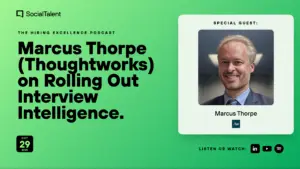
Marcus Thorpe (Thoughtworks) on Rolling Out Interview Intelligence
Marcus Thorpe shares how Thoughtworks deployed interview intelligence across 19 countries, cutting feedback time from 72 hours to under 24 hours and saving 30,000 annual hours. Learn the business case, vendor selection, pilot strategy, and how to overcome internal resistance.
 Johnny CampbellHost · Co-founder & CEO, SocialTalent
What you'll learn
Quantify hours lost to manual scorecards to build the tool's business case
Capture structured feedback on rejected candidates to revisit as silver medalists
Restrict recording access to build trust and keep opt-out rates low
Pilot the tool internally before wider rollout to surface issues early
00:00
--:--
Episode notes
Episode key takeaways
Marcus emphasizes that the tool empowers interviewers, not replaces them. Early concerns about AI decision-making and privacy required a clear stance: video content stays with the interviewer for their own review; aggregated insights go to the panel. Transparency on this point dropped opt-out rates to just over 1%, well below the expected 3%.
Pilot with your own team first. Thoughtworks tested on their TA function before rolling to India and the Middle East, surfacing skepticism and candidate preference data that internal stakeholders needed to hear. That feedback loop proved critical to landing change management across regions.
Setup investment pays dividends. Eight weeks from vendor decision to contract signature; four months from go-live to full pilot. Mapping interview attributes to the ATS (Greenhouse) upfront meant auto-population of feedback rather than manual copy-paste, multiplying the efficiency gain.
Feedback velocity shifted from 48–72 hours to 80%+ within 24 hours, enabling faster hiring decisions. Silver medalist re-engagement hasn't yet driven hires, but the time savings and structured debrief data are already meeting the original ROI target.
Good to know
Frequently asked questions
The quick answers behind this episode.
What is interview intelligence and why are companies adopting it? +
Interview intelligence tools integrate with video conferencing platforms (Zoom, Google Meet) to record, transcribe, summarize, and analyze interviews. They generate insights for individual interviewers and interview panels, enabling data-driven, objective hiring decisions. Post-COVID normalization of video interviewing removed adoption friction, and the efficiency gains—especially at scale—justify the investment.
How long does it take to go from vendor selection to full rollout? +
Thoughtworks took eight weeks from decision to signed contract, then two months of setup (mapping attributes to the ATS, integrating with Zoom and Greenhouse) before piloting with their TA team in April. Full regional rollout followed over the next few months. Speed depends on upfront legal, compliance, and technical prep work.
What were the main internal concerns and how were they addressed? +
Interviewers worried about privacy and surveillance. Thoughtworks addressed this by limiting video access to the interviewer alone; aggregated insights go to the panel, not individual performance reviews. Recruiters feared losing ad-hoc phone screening; pilot data showed candidates preferred scheduled, structured conversations. Transparency on intent and quick wins from candidate feedback helped land change management.
What was the measurable ROI at Thoughtworks? +
Feedback submission moved from 48–72 hours to 80%+ within 24 hours. The organization saved approximately 30,000 annual hours previously spent on scorecard completion and chasing detail. Structured debriefs improved decision quality. Silver medalist re-engagement pipeline is building but hasn’t yet driven hires.
What advice would you give to a TA leader considering this tool? +
Start with a business problem, not the tool. Frame ROI in terms your CFO understands (time, cost, capacity). Invest heavily in setup—map questions and attributes to your ATS upfront. Pilot internally first to surface skepticism and refine messaging. Be transparent with candidates and interviewers about intent. Demonstrate quick wins early to land change management.