Continuous learning is no longer optional. In a world where AI is reshaping how leaders operate, those who resist adaptation will lose—regardless of tenure or past success. At 76, Marshall remains in the top 50 LinkedIn creators globally precisely because he treats AI as a learning tool, not a threat.
The Hiring Excellence Podcast · Episode 184
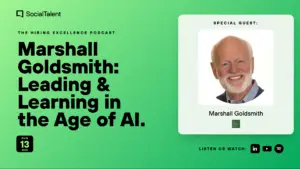
Marshall Goldsmith: Leading & Learning in the Age of AI
Marshall Goldsmith shares how AI can amplify leadership coaching at scale—and why treating it as a strategic partner, not a secretary, changes everything. Learn how to lead through technological change without sacrificing the human judgment that matters most.
 Johnny CampbellHost · Co-founder & CEO, SocialTalent
What you'll learn
Treat AI suggestions like advice: listen, weigh, then decide for yourself
Ask AI what you've left out to uncover your own blind spots
Commit to continuous learning with AI to stay professionally relevant
Screen new content for cultural sensitivities before you publish it
00:00
--:--
Episode notes
Episode key takeaways
Empathy and knowledge are not correlated. The assumption that AI erodes empathy misses the point: demonstrating empathy is a leader's responsibility, not a machine's. Technology won't make you more or less empathetic—that choice lives in your heart and your decisions.
Treat AI as a partner with an IQ of 400, not a secretary. Most leaders waste high-capability tools on administrative tasks. Instead, use AI to tackle complex problems—co-CEO transitions, cultural sensitivity in global communications, leadership philosophy gaps—where it can surface ideas faster and more comprehensively than you could alone.
114,000 questions reveal what leaders actually need. The marshallgoldsmith.ai bot shows that 85–90% of leadership questions cluster around the same timeless themes—delegation, change management, accountability—but with a growing subset about how to use technology itself to lead better.
One quote can change a trajectory. 'What got you here won't get you there' encapsulates the core challenge: the non-AI playbook that built your career won't sustain it. Leaders who embrace this frame—and act on it—will outpace those who cling to what worked before.
Good to know
Frequently asked questions
The quick answers behind this episode.
How good is AI advice on real management problems? +
AI delivers solid options—typically 7–8 ideas per question—but requires adult judgment. Treat it as a source of information, not gospel. If you disagree with 6 out of 7 suggestions, you’ve still won: one useful idea, zero cost, minimal time. The responsibility for decision-making stays with you.
Can AI coaching replace human executive coaches? +
No. AI excels at information and knowledge sharing—answering specific questions, surfacing frameworks, providing consistency. But coaching rooted in Socratic questioning, relationship, and accountability requires human presence. AI is a supplement that frees coaches to focus on deeper work, not a replacement.
What's the risk of leaders losing empathy by relying on AI? +
Empathy is a choice, not a byproduct of knowledge. Bright people can be empathetic or cold regardless of their information sources. AI won’t erode empathy—your leadership values and daily choices do. The machine is neutral; the responsibility for demonstrating care belongs entirely to you.
How do I know if an AI tool is trustworthy for leadership advice? +
Look for transparency about bias. Every AI is biased by design—the question is whether that bias is intentional and disclosed. A tool built and endorsed by a trusted voice in your field, with clear values and a track record, is more reliable than a generic model. Always verify claims against your own context.
What leadership fundamentals matter most during AI disruption? +
Stay open-minded and commit to continuous learning. AI can accelerate your growth if you use it to identify gaps, challenge assumptions, and explore new approaches. The leaders who thrive won’t be those who hide from technology—they’ll be the ones who treat it as a thinking partner and adapt faster than their peers.