A production mindset treats employees as human cogs optimized for output. Cultivation mindset, by contrast, recognizes that people are genetically hardwired for growth—the manager's job is to remove obstacles and provide what they need to thrive, not police their productivity.
The Hiring Excellence Podcast · Episode 44
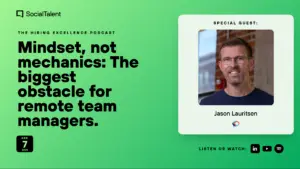
Mindset, not mechanics: The biggest obstacle for remote team managers | with Linda Jonas & Jason Lauritsen
Distributed teams fail when leaders cling to industrial-age management. Linda Jonas and Jason Lauritsen explain why cultivation mindset—not Zoom skills—determines remote team success, and how to build it.
 Johnny CampbellHost · Co-founder & CEO, SocialTalent
What you'll learn
Shift from a production mindset to a cultivation mindset for remote teams
Reduce meeting overload by agreeing never to meet when email will do
Establish predictable one-on-one and team meeting cadences to cut uncertainty
Define expected output before work starts to prevent exploitation
00:00
--:--
Episode notes
Episode key takeaways
Uncertainty drives disengagement faster than any policy. When leaders leave remote work arrangements undefined—someday you'll relocate, we just don't know when—employees fill the gap with worst-case stories. Regular, predictable one-on-ones and team meetings reduce that anxiety and rebuild trust.
Jason Lauritsen argues that most organizations have inherited mindsets about remote work from the industrial era: everyone works at the same time, visibility equals productivity, synchronous meetings are non-negotiable. These beliefs are invisible until unpacked, and they actively sabotage distributed teams.
Zoom fatigue isn't caused by too many meetings; it's caused by too many *bad* meetings. Before scheduling anything, ask: Is this synchronous? Could it be asynchronous video, email, or Slack? Does it need a decision or just information? Fewer, intentional meetings beat constant calendar noise.
Leaders set the tone through action, not words. If you tell your team to take time off but never do, or preach well-being while burning out, employees will ignore your words and copy your behavior. Parenting out loud, taking sabbaticals, and protecting your own boundaries give permission for others to do the same.
Good to know
Frequently asked questions
The quick answers behind this episode.
What is a cultivation mindset in remote management? +
It’s a framework borrowed from farming: instead of managing for compliance and output, you focus on creating the conditions for people to grow. You identify what your team needs to perform—clarity, autonomy, connection, resources—and remove obstacles. It assumes people are intrinsically motivated to learn and perform, not that they need surveillance.
How often should remote managers meet one-on-one with their team? +
Weekly one-on-ones are the foundation. They should be scheduled, predictable, and reliable so employees know they can count on them. The key is consistency and meaningful conversation, not frequency. Pair these with regular team meetings. The goal is to reduce uncertainty and create a cadence of connection, not to maximize meeting time.
How do you balance regular communication with Zoom fatigue? +
Don’t assume everyone needs the same cadence. Ask your team what works for them—some thrive on more interaction, others struggle with isolation. Focus on quality over quantity: eliminate meetings that email or asynchronous video could replace. Set team agreements: never schedule a meeting if an email will do. Establish no-meeting days and protect deep work time.
What's the difference between synchronous and asynchronous work? +
Synchronous means everyone participates in real time (meetings, calls). Asynchronous means work happens on individual schedules (recorded video updates, Slack threads, email). Many update meetings, status reports, and information-sharing can be asynchronous, freeing people to work when they’re most productive and respecting different time zones and caregiving responsibilities.
How does a manager's personal well-being affect remote team culture? +
It’s foundational to credibility. If you tell your team to prioritize well-being but never take time off or work constantly, they won’t believe you. Employees watch what leaders do, not what they say. Taking sabbaticals, leaving at 3 p.m. for a doctor’s appointment, or visibly protecting boundaries gives permission for others to do the same and signals that well-being is real, not performative.