Transparency and shared uncertainty build trust faster than false confidence. When leaders admit they don't have all the answers and invite the team into problem-solving, people step up—not out. This proved critical in the first weeks of the war when Indigo's priority shifted from business continuity to ensuring every team member was safe, then gradually pivoting back to delivery.
The Hiring Excellence Podcast · Episode 118
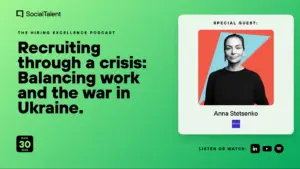
Recruiting through a crisis: Balancing work and the war in Ukraine | with Anna Stetsenko and Darja Gornitska
How do you keep a recruitment business running during a war? Anna and Dasha from Indigo Tech Recruiters share lessons on team resilience, transparent leadership, and staying profitable while supporting displaced talent across the globe.
 Johnny CampbellHost · Co-founder & CEO, SocialTalent
What you'll learn
Prepare business continuity plans before a crisis fully unfolds
Prioritize checking on team safety before resuming business operations
Hold space for candidates' emotions during a crisis interview
Challenge age bias by hiring and training older candidates
00:00
--:--
Episode notes
Episode key takeaways
Remote-first infrastructure isn't a perk; it's a survival mechanism. Having operated fully remote since 2008, Indigo was already equipped to function across geographies and time zones when the war forced dispersal. Today, 70% of placements are outside Ukraine, and the team delivers across US, UK, Switzerland, and LatAm—proving that crisis-tested remote practices scale.
Caring for people and delivering results aren't trade-offs; they're the same decision. The business reduced headcount in September but maintained service quality by rotating coverage, supporting candidates emotionally during interviews, and treating client relationships as partnerships rather than transactions. This approach retained both talent and customer trust.
Second navigation—using values and beliefs as a compass when the landscape disappears—replaces reactive crisis management. Anna's metaphor of ancient Greek navigation (coastline vs. stars) captures how Indigo's core values—care, deliver, improve—became the decision-making framework when external conditions became unpredictable.
Diverse hiring and education unlock resilience in the workforce. Training 50+ people aged 55+ in sourcing, then hiring one into the team, broke age bias and brought fresh perspective. This practice of investing in underrepresented talent pools strengthened the business's ability to adapt and scale during crisis.
Good to know
Frequently asked questions
The quick answers behind this episode.
How do you keep a recruitment business running during a war? +
Prioritize team safety first—establish clear communication channels, check in constantly, and create contingency plans before crisis hits. Once immediate safety is secured (typically 2–3 weeks), shift focus to supporting emotional stability through yoga, psychology sessions, and peer support. Then gradually resume business operations with rotating coverage and flexible scheduling to account for power outages and displacement.
Should companies work with Ukrainian recruitment agencies during the war? +
Yes. Ukrainian tech talent remains world-class, and remote-first operations mean service delivery is unaffected. Balancing risk by splitting work between Ukraine-based and diaspora teams mitigates exposure. More importantly, working with Ukrainian firms now is corporate social responsibility—when the war ends, early partners will have built loyalty and competitive advantage in a recovering market.
How do you lead a team through uncertainty when you don't have answers? +
Be honest about what you don’t know and invite the team into the problem. Share challenges openly, discuss options together, and make decisions collaboratively. When people understand the full picture and feel heard, they support tough calls—including layoffs—because they trust the reasoning. Transparency builds resilience faster than false certainty.
What role does remote work play in crisis resilience? +
Remote infrastructure allows teams to function across geographies, time zones, and disruptions. Indigo operated fully remote since 2008, so the war didn’t force a painful transition. Today the team delivers globally despite power outages and displacement because processes, tools, and culture were already built for distributed work.
How does diverse hiring strengthen a business during crisis? +
Diverse teams bring multiple perspectives to problem-solving, which is critical when conditions change rapidly. Indigo’s program training 50+ people in sourcing broke age bias and brought fresh thinking. Hiring one into the team proved that investing in underrepresented talent pools strengthens adaptability and resilience when crisis hits.