Efficiency without effectiveness is noise. Blasting 200 candidates with automated, impersonal outreach may save time but kills response rates. The real win is connecting every tool and process to a measurable business outcome—whether that's revenue impact, time-to-productivity, or quality of hire.
The Hiring Excellence Podcast · Episode 168
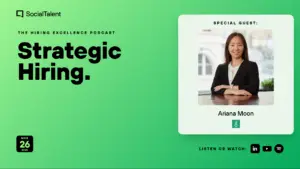
Strategic Hiring with Ariana Moon: Talent Planning at Greenhouse
Shifting from speed-obsessed hiring to strategic talent planning requires new KPIs, intentional friction in approval processes, and alignment with business goals. Ariana Moon shares how Greenhouse rethinks TA leadership for sustainable growth.
 Johnny CampbellHost · Co-founder & CEO, SocialTalent
What you'll learn
Distinguish real efficiency from effectiveness when adopting new tools
Rethink org design before automatically backfilling every departing role
Reduce scorecard review time from thirty minutes down to ten
Anticipate candidate verification challenges as AI use becomes widespread
00:00
--:--
Episode notes
Episode key takeaways
Backfill rate is the new KPI that matters. When someone leaves, the instinct is to refill the same role. Instead, dynamic resource planning asks: should we repurpose this budget elsewhere, return it to the business, or hold it? That conversation moves from hiring manager to executive level and unlocks strategic optionality.
The fast-cheap-good triangle is always in tension. TA leaders were trained to optimize for speed. But business context changes the equation. In 2024, Greenhouse shifted from 'hire at all costs' to paced hiring aligned with economic uncertainty—proving that the right metric depends on what the business is actually trying to accomplish.
Technology adoption requires a growth mindset, not just a tech stack. Introducing BrightHire reduced interview scorecard time from 30 minutes to 10 minutes across 5,000+ interviews—but only because recruiters embraced the shift from note-taking to strategic partnership. Not every recruiter makes that leap.
Candidate verification is the next frontier. AI-generated resumes, deepfakes in interviews, and mass applications have created a signal-to-noise crisis. Forward-thinking companies are reconsidering in-person interviews for leadership roles and rethinking take-home assignments to verify actual candidate capability versus AI-assisted output.
Good to know
Frequently asked questions
The quick answers behind this episode.
What is talent planning and acquisition (TPNA) and how does it differ from traditional TA? +
TPNA mirrors financial planning and analysis (FP&A) by treating talent strategy as a core business function, not just a hiring operation. It means planning for the right talent, enabling growth, and aligning headcount decisions with executive goals—not just filling requisitions as they arrive. The shift moves TA from reactive to strategic.
How should TA KPIs change when moving to a planning-based model? +
Backfill rate becomes critical: when someone leaves, how often do you refill the same role versus repurposing the budget? Other metrics include capacity carve-out for process evolution, adoption rates of new tools, and alignment of hiring pace to business goals—not just time-to-hire or cost-per-hire.
How can recruiters add strategic value when AI and automation handle routine tasks? +
Freed-up time should shift toward talent mapping, external benchmarking, and deeper partnership with hiring managers. Instead of processing applications, recruiters can surface market insights on role competitiveness, tenure patterns, and candidate availability—turning them into strategic advisors rather than process operators.
What is the difference between efficiency and effectiveness in recruiting? +
Efficiency means doing more with fewer resources or less time. Effectiveness means the outcome actually drives business results. A tool that contacts 200 people with one click is efficient but ineffective if the impersonal message gets ignored. True operational excellence connects time saved to measurable outcomes.
How should companies handle AI use in candidate interviews and assessments? +
Rather than banning AI, set a clear stance: no misrepresentation or plagiarism, whether AI-assisted or not. Some roles (e.g., engineering) can welcome AI use to assess prompting skills. The key is verifying the candidate’s actual capability and identity—especially critical as deepfakes and AI-generated applications become more common.