Technology is a double-edged sword. Using the inversion principle—asking how tech could worsen employee experience rather than improve it—reveals that many organizations deploy tools without solving actual problems. Leadership clarity, autonomy, and mission matter far more than sophisticated HR platforms.
The Hiring Excellence Podcast · Episode 22
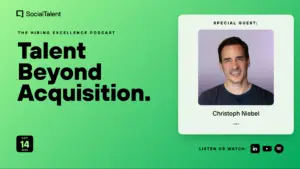
Talent Beyond Acquisition with Christoph Niebel
Christoph Niebel, president of Pontoon Solutions, challenges the siloed approach to talent acquisition and argues for a holistic talent strategy that spans hiring, development, mobility, and exit. Learn how to break down functional barriers and align talent decisions with business outcomes.
 Johnny CampbellHost · Co-founder & CEO, SocialTalent
What you'll learn
Invert the question and ask how technology could worsen employee experience
Read survey response rate itself as a signal of employee engagement
Replace degree requirements with skills-based assessments to boost applicant diversity
Broker surplus talent from one employer into another company's demand spike
00:00
--:--
Episode notes
Episode key takeaways
Degrees function as accreditation shortcuts that exclude talent. Google's career certificates and Disney's Code Rosie program demonstrate that skills-based hiring and internal reskilling unlock diversity and performance gains that traditional degree requirements block. Companies like Deloitte saw 28% diversity increases by replacing GPA filters with skills assessments.
Christoph argues that restructuring and hiring are two sides of the same coin. When companies lay off 1,000 people while hiring 1,200, they waste money on both ends. The Lufthansa-Amazon employment bridge model shows how to redirect surplus talent to high-demand roles through temporary assignments, upskilling, and voluntary engagement.
Talent acquisition leaders must shift from functional optimization to business outcome thinking. Instead of asking 'How do I hire efficiently?' ask 'What skills does the business need in place?' This reframe—from hiring to capability planning—opens the door to retrain, redeploy, borrow, and lend talent rather than defaulting to external recruitment.
Moments matter, especially in virtual environments. A 30-second personalized video reply to every new LinkedIn connection creates goodwill and humanizes leadership before day one. Small gestures of recognition compound into organizational energy and make execution easier downstream.
Good to know
Frequently asked questions
The quick answers behind this episode.
How can we move beyond degree requirements in hiring? +
Replace GPA and university filters with skills assessments. Test for the actual abilities the role demands, regardless of candidate background or education. Deloitte’s experience shows this approach increases diversity by 28% while improving performance. Pair assessment with internal reskilling programs to build talent supply where external markets fall short.
What is an employment bridge and how does it work? +
An employment bridge connects companies with talent surplus to those with talent demand. Lufthansa’s catering staff moved temporarily to Amazon during peak seasons via a staffing partner, with government support, upskilling, and voluntary engagement. It reduces restructuring costs, fills hiring gaps, and preserves employee relationships—a win for all three parties.
How should HR technology be evaluated? +
Start by defining the problem you’re solving, not the technology available. Ask: Does this tool reduce friction for employees and leaders, or does it add complexity? Response rates on engagement surveys correlate directly with engagement itself—high response means high engagement, low response means low engagement. Tech should remove work that prevents human connection, not replace it.
Why do talent acquisition teams operate in silos? +
Functional leaders optimize for their own outcomes—TA for cost-per-hire, employee relations for restructuring efficiency—rather than business capability. Breaking silos requires reframing the conversation around business outcomes (e.g., ‘deliver flu vaccines’) rather than functional tasks (e.g., ‘hire X people’). This invites collaboration across TA, L&D, finance, and operations.
What's the first step for a new TA leader with expanded remit? +
Understand what drives the business and who the real customer is. Collaborate across finance, operations, and other functions to define the outcome, not just the hiring target. Use moments of connection—personalized video messages, one-on-ones—to build trust before scaling process changes. Empathy and business acumen matter more than functional expertise.