Career development isn't a single upward path anymore. The LEVER framework—lateral, enrichment, vertical, exploratory, realignment, and relocation moves—gives managers a concrete way to discuss multiple career options without defaulting to promotion as the only reward.
The Hiring Excellence Podcast · Episode 40
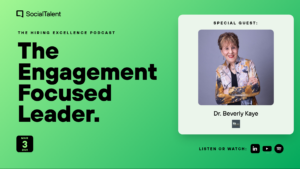
The Engagement Focused Leader | with Dr. Beverly Kaye
People don't leave organizations—they leave managers. Beverly Kaye breaks down the three clusters of engagement-focused leadership: development, relationships, and culture. Learn the frameworks that have kept talent in place for over two decades.
 Johnny CampbellHost · Co-founder & CEO, SocialTalent
What you'll learn
Apply the lever framework to open real career development conversations
Recognize that praise matters more than pay for retention
Identify the boss behaviors that drive employees to quit
See company culture as the behavior hidden below the surface
00:00
--:--
Episode notes
Episode key takeaways
Managers underestimate the power of recognition. Research shows praise matters more than pay, yet many skip it for high performers, assuming they already know their value. Hearing it directly from a manager changes everything.
Trust isn't built top-down; it's a compilation of manager behaviors across all 26 letters of the alphabet. Beverly's research found that 70% of variance in employee engagement is attributed to leaders—making the daily micro-actions (asking how someone's home workspace is working, announcing bad days, listening deeper) the real drivers of culture.
Remote work has amplified the importance of information flow and wellness conversations. The rumor mill thrives in silence; managers who proactively ask 'How's it going?' and address the full spectrum of life stressors—not just work tasks—create the conditions for sustained engagement.
Engagement is a two-way street. Individuals must take ownership of asking for what they want and following up; managers must ask the right questions and do what they can. Neither party can outsource responsibility to the other.
Good to know
Frequently asked questions
The quick answers behind this episode.
What's the difference between a manager and a leader? +
Both roles require the same skill set. A manager has to lead, and a leader has to manage. The distinction between the two titles matters less than ensuring both functions—direction-setting and execution—happen simultaneously. Splitting them creates gaps.
How do you give meaningful recognition without a promotion budget? +
Use sentence starters to move beyond ‘good job.’ Ask ‘What knocked your socks off?’ or ‘What was particularly wonderful?’ Reward comes in many forms—flexibility, learning opportunities, public acknowledgment—and only counts if the recipient experiences it as a reward, not an obligation.
Why do engagement surveys show no improvement after training investment? +
Career development often gets misinterpreted as training when employees actually want bigger titles or salary. One-on-one conversations using frameworks like LEVER clarify what ‘development’ means to each person. Investment without dialogue wastes resources and erodes trust.
How do you build culture in a remote-first environment? +
Culture isn’t just the visible part of the iceberg—it’s the subtle behaviors managers condone and model. In remote settings, proactive check-ins about workspace, wellness, and information clarity replace hallway conversations. Managers must ask ‘How’s it going?’ and genuinely listen, not assume silence means engagement.
What are the four success drivers that sit outside the three clusters? +
Ask (every intervention requires a manager question), Buck (do something or ask ‘what else’), Numbers (calculate the cost of turnover to justify the effort), and Zenith (it’s never finished—you repeat it differently for every person, forever).